WhyReservoir

Reservoir Health helps organizations shape the policy, narrative, and market environments to enable health care innovation to reach patients.
We integrate policy, market enablement, and communications to shape how health care innovations are understood, valued, accessed, and adopted. We work with organizations developing new therapies, devices, diagnostics, digital health solutions, and models of care.

Robert is the Founder and President of Reservoir Communications Group. Immediately prior to founding Reservoir Robert was the Chief Advocacy and Alliance Development Officer for WellPoint, Inc. (now Elevance Health), one of the nation’s leading health benefits companies. Prior to joining WellPoint, Robert was President, Americas for APCO Worldwide, a global public affairs and strategic communications firm. During Robert’s two decades of experience in communications and advocacy he has become known for his work helping clients rethink previously intractable problems, taking innovative approaches to advancing policy goals, and helping organizations build strong and enduring brands that can help advance their business and policy objectives.

Megan Tucker brings 25+ years of U.S. and global experience in pharmaceuticals, public health, corporate communications and stakeholder engagement. She counsels clients with a broad range of business, reputation and advocacy needs, and drives the operations for the firm.
Megan came to Reservoir after nearly a decade at Edelman, where she led the firm’s relationship with a global nutrition and wellness company, with a scope that spanned strategy, digital, media, PR programming, research and employee engagement. While primarily based in Washington, D.C., she was one of the firm’s inaugural Global Fellows and spent two years building and managing the Healthcare practice for Edelman United Arab Emirates and the Africa-Middle East region.
Megan was also a leader in GolinHarris’ social marketing practice, managing several non-profit and government client accounts; previous positions included The Georgetown Journal of International Affairs and The New Republic, two nationally distributed publications. She holds a B.S. in Foreign Service from Georgetown University.

Gretta Stone is an experienced policy and communications leader with deep knowledge of the biopharmaceutical sector and the health system more broadly. Drawing on her 20+ years of public affairs experience, she provides clients with thoughtful strategies to address complex challenges.
Before coming to Reservoir, she spent 15 years at the Pharmaceutical Research and Manufacturers of America (PhRMA), where she led a range of priority issues related to the value and cost of medicines, the R&D process and incentives for innovation. Gretta also serves on the board of the Society for Women’s Health Research, an organization dedicated to advancing our understanding of the biological differences in disease and advocating to enhance women’s health. Prior to joining PhRMA, Gretta worked in a lab researching language and the brain at Georgetown University, where she received a B.S. in biology.

Clare is an Executive Vice President at Reservoir Communications Group with significant experience leading corporate communications, rapid response and crisis media efforts, brand management, and advocacy campaigns.
Prior to joining Reservoir, she led external communications for Morgan Health, a business unit within JPMorgan Chase focused on improving the quality, equity, and affordability of employer-sponsored health care. In this role, Clare managed the organization’s executive thought leadership, content development, media engagement, and event management for the Morgan Health team as well as support for its portfolio companies.
She also served as the lead spokesperson and press secretary for America’s Health Insurance Plans (AHIP), the national trade association representing the health insurance industry. Clare oversaw the industry’s communications strategy and media engagement on key policy issues, including the Affordable Care Act, Medicare Advantage, Medicaid Managed Care, and federal and state legislative priorities.
Before joining AHIP, Clare was an associate at APCO Worldwide, a global public affairs and strategic communications firm, where she managed campaigns spanning global and national healthcare issues, including the launch of a national advocacy effort around expanded access to childhood vaccines and health plans’ wellness and prevention efforts.
Clare has a B.A. in Journalism from Indiana University and completed her M.B.A. at the University of Maryland.

Eva possesses deep knowledge of the healthcare industry, having advised biopharmaceutical and digital health companies, high-growth start-ups, non-profits, integrated health systems, university research programs, grassroots advocacy campaigns and government agencies on communications and advocacy efforts. Before joining Reservoir, Eva was a vice president at a strategic communications and public affairs firm where she developed programs to advance corporate goals, execute thought leadership strategies, and establish healthcare technology companies for growth with biopharma, enterprise, providers and payers. In addition to working as a government contractor for the National Institutes of Health and at a global public relations firm, she previously led communications strategy for a District of Columbia health system that combined a Medicaid health plan, pediatric specialty hospital, home health agency and parent foundation to support people with disabilities.

Setareh Samii is an innovative public affairs leader with nearly 15 years of experience at the intersection of healthcare business and policy. She leverages her creativity and deep knowledge of the healthcare ecosystem to lead environment shaping and policy communications efforts that enable patient access and drive positive business outcomes for clients.
Before joining Reservoir, Setareh spent several years on the Policy & Research team at the Pharmaceutical Research and Manufacturers of America (PhRMA), where she provided a broad range of policy expertise on key federal advocacy priorities for the biopharmaceutical industry, including intellectual property, industry economics, venture capital, and STEM education. She has also held positions at APCO Worldwide and the J. Craig Venter Institute.
Setareh holds a J.D. from the George Washington University, where she also completed a B.A. in International Affairs with a focus on Global Public Health.

Courtney Tyne has more than 15 years of experience in the field of health policy and public affairs, focused on market readiness, cost of care issues, and health care access communications. She has experience developing and leading programs focused on identifying strategies that support high-value, patient-centric access to care strategies, and she works to translate that knowledge into policy-oriented activations and communications for a variety of audiences. Courtney has planned and executed a variety of value, access and policy-related projects, from corporate narratives to product-specific messaging, to stakeholder awareness and education, to executive thought leadership and white papers and issues briefs, all to elucidate solutions-oriented access strategies.
Courtney came to Reservoir from Real Chemistry, where she led the Pricing and Public Affairs team in DC. She previously worked with the American Society of Clinical Oncology (ASCO), managing the development of its value of cancer care initiative.
She earned her M.P.H. with a specialization in health care policy from the University of Texas Health Science Center School of Public Health and has co-authored publications with experts in the field of oncology and policy, including a seminal publication on assessing value in oncology. As part of her post-graduate work in public health policy, Courtney served as a graduate intern for the House of Representatives Ways and Means Subcommittee on Health researching issues related to healthcare provision, insurance, and federal policy.

Allison DeBattista brings 15 years of experience in coalition building, advocacy, and strategic communications to the team, particularly within the healthcare sector. Her strategic approach to recruiting stakeholders to advocate for healthcare policy reforms has significantly impacted state and federal policy outcomes on behalf of clients. She has a proven track record of leading successful campaigns, managing key client relationships, and driving legislative and policy changes.
Before relocating to Washington, D.C., Allison was a director at Moore in New Orleans, where she led significant public relations and advocacy projects across the Southeast. She played a key role in organizing one of Louisiana’s largest healthcare coalitions, skillfully navigating complex issues through strategic grassroots and grasstops engagement and effective media relations.
Earlier in her career, Allison was the Executive Director of Epilepsy Alliance Louisiana, where she co-founded and launched Epilepsy Alliance America. Her leadership extended to developing a physician advisory board and serving as the organization’s spokesperson, underscoring her commitment to patient advocacy and public health. Allison has a Bachelor of Business Administration degree from the University of Mississippi and continues to participate in extensive volunteer work, including board memberships with various health organizations.

Elisabeth M. Oehrlein, Ph.D., MS, is a mixed methods researcher who leads qualitative and quantitative primary data collection studies to produce actionable patient and caregiver insights across the medical product lifecycle. Her expertise includes patient-centered evidence generation, clinical outcome assessment (COA) strategy and development, and patient-centered evidence planning. She partners with life sciences companies and patient organizations to identify patient-centered evidence needs, prioritize research investments, and develop evidence that reflects patients’ lived experience, unmet needs, burden of disease, and desired outcomes to inform research, development, regulatory, access, and post-launch decision-making.
Dr. Oehrlein founded AppliedPX, a patient-centered research and strategy consulting firm that was acquired by Reservoir in 2026. She currently serves as Principal Scientist at AppliedPX and Executive Vice President and Head of Patient Engagement at Reservoir. Prior to founding AppliedPX, she served on the National Health Council senior leadership team, where she directed research and educational initiatives focused on patient engagement, value assessment, and real-world evidence. She has spoken widely on patient-centered research, including invited presentations at the National Academy of Sciences and briefings to the Rare Disease Congressional Caucus. She has published extensively in medical, economic, and health policy journals and serves as an Associate Editor of Value in Health.
Elisabeth holds a BA from Franklin & Marshall College, an MS in Epidemiology from the University of Maryland School of Medicine’s Department of Epidemiology and Human Genetics, and a Ph.D. in Pharmaceutical Health Services Research from the University of Maryland School of Pharmacy.

Ashley Flint is a policy expert and strategist with nearly 15 years of experience advising life sciences companies on how to navigate a rapidly evolving policy environment to achieve business objectives. She leverages her deep expertise on federal and state policy issues, with a focus on Inflation Reduction Act (IRA) implementation, drug pricing, Medicare Part D, and the 340B program, to develop creative policy solutions and advocacy strategies for clients.
Before joining Reservoir, Ashley was a Principal at Avalere Health, working with several life sciences and health plan clients on drug pricing policy issues. Previously, Ashley served as Director of U.S. Policy & Analytics at AbbVie, where she led a team responsible for analyzing proposed federal and state policies related to above-brand market access issues and developing policy positions and strategies to advance business priorities. Earlier in her career, she was a Senior Director for Policy & Research at PhRMA, where she served as the Part D policy lead.
Ashley holds a MPP in health policy from the George Washington University and a BA in Political Science and Psychology from Emory University.

Bryan Dumont is a leader in the field of reputation management and corporate branding. Bryan has helped the world’s leading companies apply research and measurement tools to develop and execute multi-stakeholder campaigns, initiatives, and programs. He has pioneered methodologies to enhance the insights & analytics used by corporate affairs executives. He is a frequent speaker on the latest trends in corporate communications, strategic analytics, and how reputation and corporate brands provide measurable impact on tangible business outcomes
Bryan previously directed enterprise-wide reputation strategy and insights for Exelon Corporation, the largest publicly traded utility and power generator. Bryan came to Exelon in a newly-created research and analytics function to inform enterprise-wide decisions with insights, marketplace intelligence, and data-driven evidence. In this position, he developed one of the most robust insights & analytics functions of any Fortune 100 company. Before joining Exelon in 2017, he was a partner at the Brunswick Group in its London office where he helped clients convert research insights and strategy into corporate campaigns and programs.
He led the corporate campaigns to offer in London, serving as a “bridge” across multiple disciplines and specialisms across the firm to develop methodologies and approaches on how to create multi-stakeholder campaigns for companies.
Before moving to London, Bryan spent 16 years with APCO Worldwide where he was President for APCO Insight, based in Washington, DC, and later Brussels. Bryan was the driving force in building the firm’s research division into a global opinion research and strategy consultancy. He is the main architect of APCO Insight’s industry-leading reputation and brand research methodologies. He previously served as a Congressional staff person, management consultant at PriceWaterhouseCoopers, and research director at the Roper Center.

Kristen McCaughan is an Emmy award-winning communications executive with 20+ years of experience. She has provided strategic counsel to Fortune 500 companies in nearly every industry as well as major trade associations, universities, law firms, and non-profit organizations. In addition, she has worked with a range of media on behalf of clients including NBC Nightly News, CNN, FOX, The New York Times, The Washington Post, The Wall Street Journal, USA Today, The Los Angeles Times, NPR, Bloomberg, Reuters, the AP, and numerous local newspapers and television newscasts.
Before coming to Reservoir, Kristen was a senior vice president at McGinn and Company, a leading strategic communications firm. There she advised clients on communications strategy, led high-profile communications campaigns, elevated the thought leadership of CEOs and executives, managed crisis communications, and served as a corporate spokesperson.
Kristen previously ran marketing and communications for the National Health Service Corps, a $300 million national healthcare program, at the U.S. Department of Health and Human Services. In that role, she worked with top government leadership and oversaw strategy, budget, and resources for a 24-person communications team. Additionally, Kristen brings a deep perspective from inside the media having worked as a producer at CNN covering stories that included presidential campaigns and the events of September 11. Her work at CNN garnered her national Emmy recognition, among other awards.

Joe Vandigo, MBA, Ph.D., is a health services researcher who specializes in implementing mixed-method approaches to drive strategic decision-making. His expertise is in developing and operationalizing regulatory-grade qualitative and quantitative studies to document patient experiences, constructing and applying patient-centered methodologies, and strategically integrating the patient perspective into public and private healthcare decisions. He works closely alongside patient organizations, trade associations, and life sciences companies to document existing patient experience data, determine gaps in publicly available data, and implement innovative approaches, such as Patient Experience Dossiers, to address those gaps. His research interests include incorporating the patient perspective into asset assessment/due diligence and quantifying the time patients spend navigating access barriers, such as prior authorization.
In 2023, Joe joined AppliedPX, a patient-centered research and strategy consulting firm that was acquired by Reservoir in 2026. He is currently serving as the Vice President, Market Access & Value Strategy at AppliedPX and a Senior Vice President at Reservoir. Prior to joining AppliedPX, Joe was a member of the Novartis Market Access Innovation team, conducted research to support policy related to value assessment, hospital pricing, and innovative contracting and financing as a member of the Value-Driven Healthcare Unit at PhRMA, and built patient-centered research infrastructure at the University of Maryland PATIENTS Program.
Joe earned a BS in Finance from Southeastern Louisiana University, an MBA from the University of Louisiana at Monroe, and a Ph.D. in Pharmaceutical Health Services Research from the University of Maryland School of Pharmacy.

Casey is an experienced public affairs and strategic communications leader with 20 years of experience in policy, corporate and philanthropy communications. She has advised CEOs and senior leaders across business and politics, built and led multinational teams and developed thought leadership agendas that strengthen the reputation of global brands.
She previously led external affairs teams that spotlighted technology, philanthropy and policy priorities at JPMorgan Chase, Mastercard and McKinsey & Co.
Casey began her career in Washington, D.C. working for the Justice Department, presidential campaigns and APCO Worldwide, which shaped her approach to communications by raising awareness through an integrated, content driven, audience-first approach.
She holds an M.A. in international economics from Johns Hopkins University (SAIS) and a B.A. from Loyola University Chicago and is on the board of The Azadi Project, a non-profit organization supporting individuals in conflict-affected regions in Africa, the Middle east and South Asia.

Lauren Cohen is an integrated communications strategist with a proven track record of successfully developing and implementing public affairs and PR campaigns for Fortune 500 companies, startups, trade associations, and nonprofits. For more than a decade, she has directed data-driven communications and marketing programs, leveraging earned, paid, shared, and owned media tactics to drive business momentum and increase brand awareness.
Prior to joining Reservoir, Lauren led the Life Sciences & Health practice at Mission North, supporting both established and early-stage biotech and biopharma clients in reaching key b2b audiences through integrated communications approaches. While at Mission North, she advised c-suite clients as they went public, raised major funding rounds, hit key partner and clinical milestones, and managed through turbulent economic markets and other critical business issues.
Lauren previously served as a director in APCO’s Public Affairs practice, leading the firm’s work with some of its largest global clients across the health and technology sectors, as well as major industry coalitions. Before APCO, she led communications at the Natural Products Association, the trade association representing vitamins and dietary supplements.
Lauren holds a bachelor’s degree in journalism from the University of Maryland.

Marilyn leads our creative and digital client business, helping deliver top-quality creative content and brand storytelling for our clients. Marilyn brings more than two decades of experience in strategic communications, brand advocacy, and reputation management, producing highly effective and innovative campaigns for corporate, nonprofit, association, and government clients.
Marilyn’s expertise includes comprehensive campaign strategy and planning, message and story architecture, branding, digital analytics, copywriting, paid advertising, and executive media training, and international communications platforms. She directs integrated content development including website development, social media, branding, video production, animation, print collateral, paid advertising including television, digital/online, radio, transit, and print campaigns, sponsored/earned media, data visualization, and music composition.
Prior to working with Reservoir, Marilyn served as chief creative officer and executive director of APCO Worldwide, where she led the global digital and creative practice. Marilyn has extensive experience directing political candidate and issue advocacy campaigns, as well as live television and cable news production. Marilyn has a master’s degree in communications from the University of Washington, and bachelor of arts degrees in political science, journalism, and English from the University of Oregon.

Chrystine Zacherau is a passionate public health leader whose unique blend of clinical nursing, opinion research, and strategic planning drives real change in healthcare. With a career built on active listening and evidence-based insights, she empowers communities by elevating underrepresented voices and advocating for patient-centered care.
As a trusted advisor to global health companies, health systems, and nonprofit organizations, Chrystine has a proven track record of turning complex data into actionable strategies and content that improve health outcomes. A founding member of APCO Insight, she established a robust health-focused research capability that continues to inform industry best practices.
Beyond her professional achievements, Chrystine remains deeply committed to service. She volunteers as a nurse in Guatemala with Mayanza—a group dedicated to enhancing the health of school-aged children and their mothers—and actively supports her local public health department by staffing vaccine clinics.
Chrystine’s academic background is as diverse as her experience: she holds a B.A. in Political Science from Marist College, a B.S. in Nursing from George Mason University, an M.A. in Survey Research Methodology from the University of Connecticut, and a Public Health Certificate from Rutgers University. This multidisciplinary expertise uniquely positions her to drive innovative, sustainable improvements in public health and make a lasting impact on communities.

Mallory is a strategic communications professional who brings over 15 years of experience leading successful public affairs campaigns. She has worked with Fortune 500 companies, trade associations, not-for-profit organizations, and political candidates on messaging strategy, coalition management, crisis communications, and thought leadership programs. Mallory counsels clients on how to effectively frame the debate, drive and leverage media coverage, and influence policymakers.
Before joining Reservoir Communications Group, Mallory was a director at APCO Worldwide where she served as the deputy public affairs practice group leader. There she managed some of the agency’s largest accounts, led crisis response teams, and developed winning campaigns inside the Beltway and across the country.
Previously, Mallory was chief of staff at the New York State Democratic Party and worked on numerous political campaigns in the state. She also worked at a boutique political consulting firm in New York City and with a leading civil rights organization.
Mallory graduated magna cum laude from Barnard College at Columbia University with a B.A. in Political Science.

Kirsten Thistle has decades of experience in health care communications, public policy, advocacy campaigns, and alliance development. She brings deep expertise in vaccines, infectious diseases, and public health, leading stakeholder engagement, disease awareness, and access initiatives for leading health care organizations, nonprofits, and industry partners.
Prior to joining Reservoir Communications Group, Kirsten was co-founder and partner of Health Impact Strategies, a boutique communications agency focused on advancing public health and health equity. She also served as campaign director for Health is Primary, a national effort led by the American Academy of Family Physicians to raise awareness of the critical role of primary care in the U.S. health care system. For more than a decade, Kirsten led the U.S. Health Care practice at APCO Worldwide, advising clients across the health care, pharmaceutical, biotechnology, and nonprofit sectors.

Laurie is a trusted public affairs and communications leader with 20 years of experience in policy and corporate communications. She is a senior advisor who applies an in-depth, holistic approach to assess the environment and evolving external and internal stakeholder expectations, devising predictive strategies to help guide informed decision making and a framework for the path forward.
Laurie provides communications advice and counsel to executives and teams on a broad range of issues, including reputation management, crisis and litigation, policy, diversity and inclusion, CSR and sustainability, advocacy, and governance. Laurie also works closely with clients on privacy and security related communications including cyber preparedness and breach simulation exercises, as well as post-incident communications on behalf of clients in industries including financial services, retail, technology, and health care.
Laurie previously served as Founder and President of Alton Place Group, a specialized D.C.-based communications firm, and as Deputy Managing Director of the Washington, D.C. office of APCO Worldwide, a global public affairs and strategic communications firm. Prior to joining APCO, she served as the principal administrator of the Committee on Consumer Policy at the OECD in Paris; as Special Advisor to the Commissioner at the Federal Trade Commission (FTC), where she handled online privacy and consumer protection issues. She joined the FTC from the White House where she served as Staff Director for the White House Office of Cabinet Affairs.

Jenn brings experience leading and managing strategic health communications at the highest levels of government and for a wide array of Reservoir clients across the health sector.
Through a decade of communications work, Jenn has worked at the intersection of critical public policy conversations and legislation. She’s helped leaders respond to public health crises – including the opioid epidemic and the COVID-19 pandemic – and tackle key reforms spanning health insurance and information technology. Specifically, Jenn led the communications and media efforts surrounding the Comprehensive Addiction and Recovery Act (CARA), the 21st Century Cures Act, the FDA Reauthorization Act, and the SUPPORT for Patients and Communities Act, among others.
Most recently, Jenn was the Director of Public Affairs for the Office of the Surgeon General at the U.S. Department of Health and Human Services. In that role, Jenn oversaw all communications and media for the “Nation’s Doctor.” Prior to that, she served as press secretary for the House Energy and Commerce Committee, leading all communications for both its health and oversight & investigations subcommittees.
Jenn has a B.A. in Journalism and Mass Communication and a B.S. in Political Science from St. Bonaventure University.

Ahead of the Midterms: A Health Policy Field Guide for the 120th Congress
Election Day will determine which party controls Congress for the next two years. But party control alone won't tell us where health policy is headed.
Across both parties, affordability concerns and growing skepticism of large institutions are reshaping policy debates, creating unexpected areas of convergence alongside familiar partisan divides. Regardless of the outcome, the 120th Congress will also bring new members, committee dynamics, policy priorities and oversight agendas.
For health care organizations, the weeks surrounding Election Day should be less about predicting the outcome and more about preparing for what comes next.
Control of Congress matters, but it’s not the only thing
A Democratic majority in either chamber could significantly change the health policy landscape. New committee leaders would set different legislative and oversight agendas and gain leverage in negotiations over must-pass legislation.
Continued Republican control would provide greater continuity, but new members and evolving Trump administration priorities would still change the environment.
Beyond the topline results, organizations should watch who will lead key committees, which incoming members bring health care experience or interest, and where influence within each party may be shifting.
If Democrats gain power, consider the agenda already taking shape
Democratic policy activity in 2026 offers clues about where congressional attention could turn.
Watch for convergence, not just conflict
Some of the next Congress's most consequential health policy debates may not follow traditional partisan lines.
Recent polling suggests voters across the political spectrum are receptive to government intervention framed around affordability and fairness. That could reinforce momentum around drug affordability, PBM and insurer scrutiny, hospital costs, price transparency and policies giving consumers greater visibility into health care spending.
Republicans and Democrats may favor different solutions to these challenges. But concerns about cost, access, transparency and institutional accountability increasingly cross partisan lines, potentially creating unexpected coalitions.
That means reconsidering whether messages built around traditional partisan priorities will resonate with a changing political audience.
Oversight could matter as much as legislation
Election scenarios are often evaluated by asking: What legislation could pass? But that misses the broader context.
If Democrats gain control of at least one chamber, congressional oversight could become an immediate priority. Existing concerns could translate into hearings and investigations involving HHS and federal health agencies, Medicaid and coverage policy, vaccines and public health, and the administration's MFN initiatives and TrumpRx.
Even organizations not directly targeted could become part of broader debates through information requests, hearings, media attention or scrutiny of industry practices.
The question isn't only “What could Congress legislate?” but also “What could Congress investigate, and where might our organization or industry intersect with that scrutiny?”
Regardless of who wins, the audience is changing
New members, staff and committee assignments will create opportunities for organizations to educate policymakers on complex health policy issues. Materials developed for experienced audiences may not resonate with a freshman member or staffer encountering IRA implementation, 340B or reimbursement policy for the first time.
That changing audience extends beyond the Beltway. State elections will also bring changes in governors' offices, legislatures and committee leadership that could reshape debates over drug affordability, coverage, 340B and rural health priorities.
As affordability and accountability gain prominence across party lines, organizations must also be prepared to explain how their organizations and their policy positions deliver tangible value for patients and the health care system.
Now is the time to ask: Is our corporate narrative ready for 2027? Can new policymakers quickly understand our role and priorities? Are our messages relevant across different political environments?
Don’t wait until after November 3 to prepare
Organizations don't need election results to begin preparing. Many of the most valuable steps are “no-regret” actions that will remain relevant regardless of the outcome.
The weeks ahead offer an opportunity to refresh corporate narratives and policy messages, assess materials for new policymakers, and develop scenario-based stakeholder maps. Organizations can also identify potential legislative and oversight exposure, pressure-test positions against questions from both parties, and strengthen their arguments with additional evidence, patient perspectives or credible third-party voices.
The goal isn't to develop a separate strategy for every possible outcome but rather to understand what could change, who will need to be engaged and how to communicate value in the new environment.
The Six Fault Lines Shaping Americans’ Views on Health Care
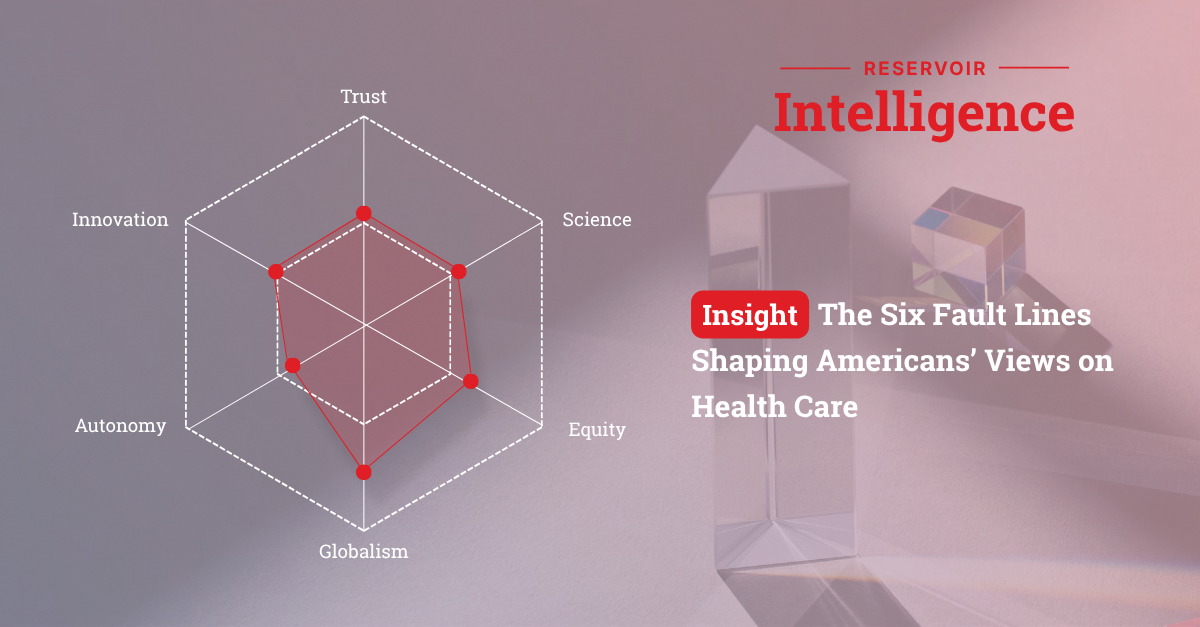
Americans’ views on health care increasingly reflect deeper values and belief systems – differences that demographics and party identification alone can’t fully explain. Understanding those differences gives us a clearer picture of how audiences may respond to messages, messengers and information sources across health care issues.
The big picture: Health care sits at the center of many of America’s biggest social, political and cultural shifts. These forces shape who people trust, what they believe and how they respond to information.
What we know: PRISM, Reservoir’s audience intelligence platform, identifies six underlying fault lines shaping Americans’ views on health care today – from personal choice to science and America’s role in the world. These fault lines allow us to model how specific audiences – including voters in key states and congressional districts, as well as federal policymakers – may respond to different messages, messengers and information sources.
Why it matters: People who look similar on the surface can reach very different conclusions – or reach the same conclusion for different reasons. Understanding what drives those views helps tailor messages and choose credible messengers and sources of information for the audiences that matter most to policy and advocacy goals.
The six fault lines, explained:
The takeaway: An effective strategy starts with understanding what drives your audiences. PRISM brings those deeper beliefs into focus, helping you connect your policy and advocacy goals to what matters to the people you need to reach.
Get in touch to learn how PRISM can inform your strategy: prism@reservoirhealth.com.
.png)
2027 State Focus: Why Rural Health Is the New Policy Bellwether
More than 66 million Americans live in rural communities, where access to care depends on far more than insurance coverage. Long distances, workforce shortages, limited broadband and transportation, and hospital and pharmacy closures can delay everything from routine screening to specialized treatment.
Rural health is a critical test of whether policy delivers care patients can actually obtain. State policymakers influence that access through Medicaid, state-regulated commercial insurance, and state employee health plans. As the 2027 legislative sessions approach, several issues will challenge their ability to turn policy commitments into practical improvements.
Rural Americans face worse outcomes and a fragile care infrastructure.
Rural residents are more likely than urban residents to die prematurely from heart disease, cancer, stroke, respiratory disease, and unintentional injuries. The CDC estimates that tens of thousands of these deaths may be preventable. Provider shortages and closures make these conditions harder to prevent, diagnose, and treat.
Policymakers must protect the resources that sustain rural care while ensuring they benefit patients. The 340B Drug Pricing Program, for example, can support eligible rural hospitals, but its savings do not automatically lower patients’ costs. The challenge is balancing financial support for local services with transparency and accountability for how those savings improve access.
Access begins long before treatment.
Covered treatments offer little benefit to patients who are never screened, diagnosed, or connected to a provider. Rural access therefore starts with primary care, prevention, and timely diagnostic testing.
Complex chronic conditions, including cancer, Alzheimer’s disease and cardiometabolic care, reflect this challenging dynamic. Biomarker testing can help identify patients likely to benefit from targeted therapies, while emerging blood-based tests offer new possibilities for early detection.
State coverage policies for biomarker testing are expanding, with opportunities to address additional conditions. Yet rural patients may still struggle to reach testing facilities and specialists. These laws also vary in which plans and tests they cover and what utilization management they permit. Policymakers must consider how prior authorization, appeals, cost-sharing, and provider availability affect whether patients receive timely testing.
Coverage does not automatically create access.
A medication can appear on a formulary yet remain difficult to obtain because of prior authorization, step therapy, or coverage changes that prompt non-medical switching. Patients may face paperwork, additional treatment trials, and appeals before receiving their prescribed therapy.
Immunology provides a clear example. A study of 17 large commercial health plans found that, across the medications studied, an average of 78.6% of plans restricted psoriasis coverage beyond the FDA label; for psoriatic arthritis, the figure was 66.8%. Medications were most commonly covered as second-line treatments. Not every restriction is inappropriate, but these findings show why formulary coverage alone is an incomplete measure of access.
Within the insurance markets they regulate, state legislators can establish timely authorization standards, workable step-therapy exceptions, and continuity-of-treatment protections. These measures can help patients obtain clinically appropriate care without avoidable delays.
Policy choices can reduce or deepen rural disparities.
The federal budget legislation enacted in 2025 will put Medicaid at the center of state debates in 2027. New eligibility requirements and financing changes will force difficult choices about coverage, services, and provider payments. More frequent eligibility reviews and work requirements for certain adults also create a risk that eligible patients will lose coverage because of paperwork barriers.
Lawmakers will need to weigh additional Medicaid funding against competing budget priorities. Reducing services or provider payments could make care harder to obtain, while underfunding eligibility systems and enrollment assistance could increase coverage losses. Their budget decisions will shape both who remains insured and whether providers can continue serving them.
Rural health presents a major policy and advocacy opportunity.
The federal Rural Health Transformation Program will direct $50 billion to states from 2026 through 2030, supporting investments in prevention, chronic disease management, workforce, technology, and new care delivery models.
Stakeholders can help shape funding priorities, implementation, and measures of success. Their involvement can keep state decisions grounded in patients’ needs across prevention, diagnosis, treatment, and follow-up care.
The test for 2027 is whether these decisions make timely, effective care easier to obtain. How states meet that challenge in rural communities will offer an early indication of whether broader health policy is improving access in practice.