Audience Intelligence for health that reveals how people encounter health care before they encounter you
PRISM is an audience intelligence platform designed to help health care organizations reach the audiences that matter most. It identifies 16 distinct health care audience segments, each shaped by an ideological and belief profile that influences how people receive, interpret, and act on health information.
Democratic health care audiences are increasingly fractured – not just by policy preferences, but by deeper beliefs about justice, reform, American leadership and the role of the private sector. For organizations trying to communicate effectively, those differences matter: a message that motivates one audience may fall flat with another.
Zooming in:
Our research has identified six distinct Democratic audience segments – each with their own unique values and belief systems.
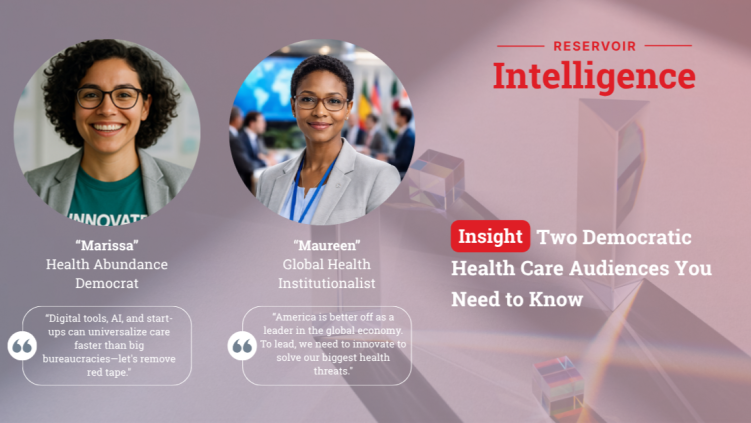
This month, we’re spotlighting two Democratic segments that look similar on traditional political measures: Both trust science. Both support innovation. Both favor public investment in health care. Yet they disagree fundamentally about progress. Messages that resonate with one often fall flat with the other.
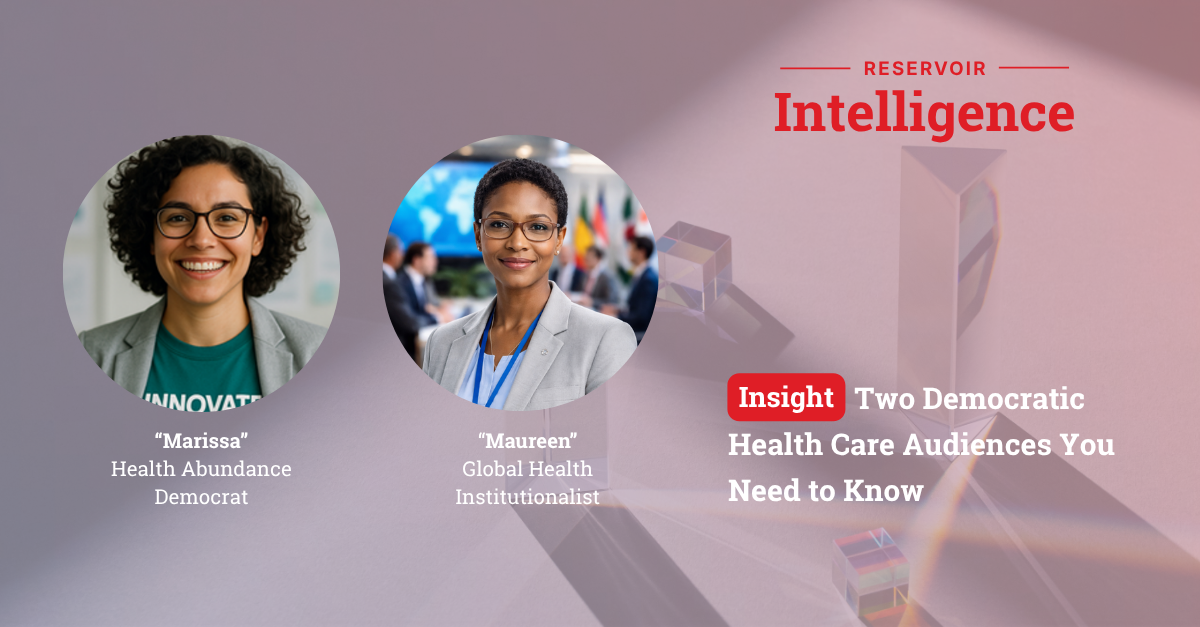
Health Abundance Democrats –Democrats who see American innovation and industry as keys to making health care more accessible. They view government as a partner in expanding health care capacity: funding research, increasing transparency, promoting affordable coverage and regulating in targeted ways that do not slow private-sector progress. For example, they are 8 percentage points more likely to support public policy that drives research to extend the human lifespan than other Americans. Culturally, they are center-left populists – patriotic, protective of American workers and more traditional on social issues than other Democratic audiences.
Global Health Institutionalists – Democrats who believe that modern health challenges like climate change, pandemics and supply chain instability transcend national borders and view coordinated global institutions as fundamental to achieving a healthier world. As a result, they are 28 percentage points less likely to favor efforts to remove the U.S. from global institutions like the World Health Organization than other Americans. They favor private-sector innovation and support strong government funding for public health institutions, but view structural reforms as key to strengthening institutions and improving access. They are socially and culturally liberal and staunchly pro-science – both in their political beliefs and in their personal lives.
The unifying thread:
Industry & Innovation. Both audiences are pro-science and pro-innovation, and both want to ensure that policy does not impede scientific progress in the private sector. But beneath that shared support for innovation are important differences in how each audience defines progress and what is required to achieve it. These differences are critical to inform strategic engagement with these audiences.
Why they’re different:
Global Focus. The most significant difference between these audiences is the geographic lens through which they view health care. Health Abundance Democrats see health care as a domestic challenge that can be addressed through American industry and ingenuity. Global Health Institutionalists see health care as a global challenge that requires international cooperation and strong global health institutions.
Reform. Health Abundance Democrats favor working within existing systems to expand the capacity of our health care system and are skeptical of broad or sweeping reforms. Global Health Institutionalists favor broader institutional reforms that improve access and affordability, while continuing to support private-sector innovation. For example, Global Health Institutionalists are 12 percentage points more likely to support single-payer reforms versus Health Abundance Democrats.
Messaging. Health Abundance Democrats respond best to messages that are pragmatic and innovation-forward. Global Health Institutionalists respond to messages that emphasize global cooperation and public health leadership and are validated by institutional experts. The same messages do not work for both audiences.
Go deeper:
Reservoir’s audience intelligence platform, PRISM, maps 16 distinct audience segments across the health care landscape, each with distinct values and belief systems.
The Health Abundance Democrats and Global Health Institutionalists are just two of six Democratic segments – each requiring a tailored approach to messaging and engagement.
For decades, it was fair to assume that people’s views on health policy fell largely along partisan lines and that their views about their own health care were typically unrelated to their policy views.
That playbook no longer applies.
Today, health care sits directly at the intersection of the major political and cultural shifts reshaping the U.S. Audiences are divided not simply by party or demographics, but by deeper questions of trust, freedom and identity. Even everyday health care decisions are interpreted through the lens of people’s underlying beliefs and values.
These divisions are increasingly visible among policymakers as well. Within both parties, competing perspectives are shaping health care debates–-from “health freedom” and “wellness” movements, to competing priorities around cost and innovation.
In this environment, identifying the right audiences—and reaching them with messages that resonate—requires a deeper understanding of how values and beliefs shape the way people interpret health care information and policy.
A New Audience Intelligence Platform: PRISM
PRISM was built for this moment. Our audience intelligence platform enables public affairs, corporate communications and brand and market insights teams to map the ideological profiles shaping health care engagement today.
At its core, PRISM maps the values and belief systems that form the “prism” through which audiences receive, interpret and act on health care information and messages—even when traditional audience categories stay the same. PRISM identifies 16 distinct health care audiences, each defined by a unique ideological profile that shapes how they think about health care.
“PRISM began with a simple realization: the categories we relied on to understand our audiences no longer match how people think about health. Patients, voters and policymakers are interpreting everything—from prevention to policy —through the lens of politics, culture, identity and trust. Once that became clear, it was obvious that we all needed a new way to see the landscape. PRISM was built to provide that map.”
Bryan Dumont, Head of Research | Reservoir
PRISM pairs audience intelligence with execution, helping clients shape strategy, sharpen positioning and communicate with precision.
Health care companies can’t afford to operate with the assumption that traditional audience targeting measures provide meaningful explanations for how people act today. Audience intelligence that maps these nuances is the competitive advantage. PRISM provides that roadmap.
Looking Ahead
In our next issue, we’ll explore important new research on how the billions of dollars being in invested in R&D and manufacturing in the U.S. by biopharmaceutical companies is being received by voters.
We’ll unpack what companies need to know to ensure these investments resonate and create the opportunity for sustained dialogue and engagement with voters.
A new study from Reservoir Communications Group reveals that U.S. biopharmaceutical investment plays an important role in driving industry reputation and informing views on policy and innovation among today’s health care audiences.
Why it matters:
U.S. biopharma companies are ramping up domestic manufacturing investments – but awareness is low. The data shows that how these investments are communicated can significantly shape reputation and policy support.
What we did:
Reservoir used PRISM, our audience intelligence platform, to measure how awareness of U.S. manufacturing investment impacts perceptions across increasingly fragmented audiences.
The big picture: Clear, targeted messaging about the scale and impact of industry investment improves reputation, strengthens belief in U.S. leadership and influences policy views.
Key findings:
Investment messaging works. Emphasizing U.S. biopharma investment increased industry favorability by 27-percentage points and belief in the importance of U.S. leadership by 24-percentage points.
Policy support rises. Highlighting investment boosts support for pro-innovation policies – with variation between audiences that reveals key opportunities for targeted engagement.
Awareness gap = opportunity. Only 35% of respondents are aware of recent U.S. investments, leaving room to raise visibility and strengthen industry perceptions.
Bottom line:
Communicating domestic investment isn’t just informative – it’s persuasive. Done right, it can improve perception, reinforce leadership and shape policy outcomes.
Go deeper:
PRISM identifies 16 audience segments, each with distinct values and beliefs.
There’s no one-size-fits-all message – impact comes from tailoring to each segment.
Our full report outlines six priority audiences and the messages that move them most.
Get in touch to learn more about how PRISM can inform your strategy: prism@reservoirhealth.com.
On both sides of the aisle audiences aresplintering on health care in ways that are increasingly driven by deep differences in trust, and fundamental beliefs on science, autonomy and market ideology.
Why it matters:
Understanding where each audience falls along these new fault lines is the first step to communicating with them effectively.
Who they are:
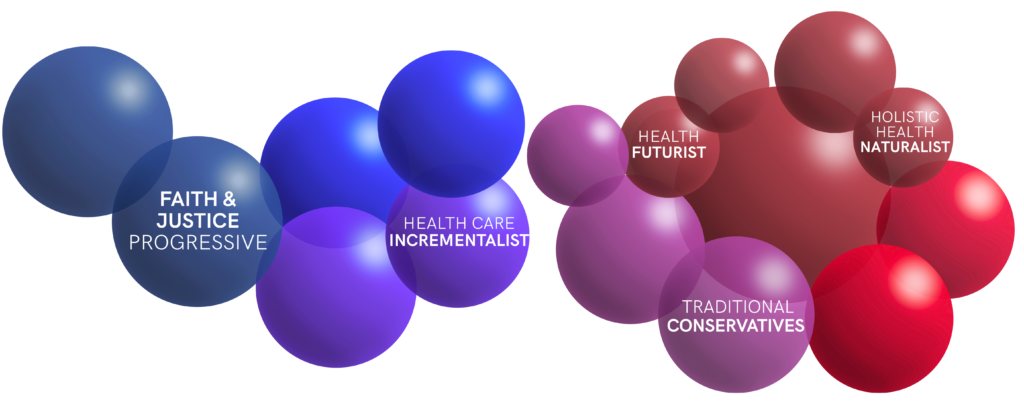
Our research has identified 16 distinct audience segments – each with their own unique values and belief systems.
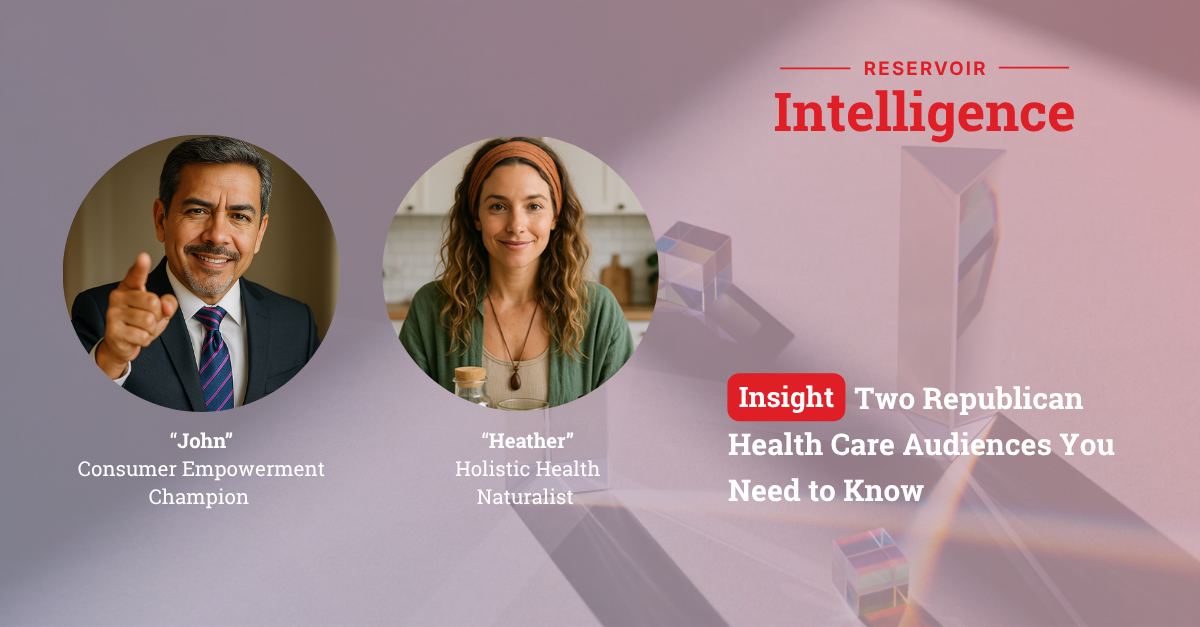
This month, we’re spotlighting two of those segments:
Holistic Health Naturalists – One of the newest GOP segments. They are former Democratic voters – one of several segments that identify as part of the Make America Healthy Again movement. They strongly prefer alternative approaches to medicine, and distrust corporations and institutions that they perceive as profiting from chronic disease. These voters became Republican not out of political ideology, but out of distrust of a system they feel has not been working for them. They, along with many of the Republican segments, have little interest in messages about free markets.
Consumer Empowerment Champions – Many are long-standing Republicans who believe the health care system is broken. They think it is riddled with middlemen, hidden costs and corporate profiteering, but that government expansion would only make it worse. They are convinced that competition, transparency and consumer empowerment are the solution. These are only among a few remaining Republican segments that respond to health care solutions focused on free markets.
Why they’re different:
Who they trust could not look any more different. Holistic Health Naturalists have the lowest trust in science and are least likely to trust doctors. Consumer Empowerment Champions trust health care providers and health technology companies more than other Americans.
Holistic Health Naturalists prioritize GMO labeling, natural remedy recognition and food transparency; Consumer Empowerment Champions want price transparency, competition and consumer choices.
Holistic Health Naturalists want to hear about alternative approaches to modern medicine and environmental sustainability. Consumer Empowerment Champions respond to solutions grounded in the free market and putting patients first. The same messages will not work for both.
Go deeper:
Reservoir’s audience intelligence platform, PRISM, maps 16 distinct audience segments across the health care landscape, each with distinct values and belief systems.
The Holistic Health Naturalists and Consumer Empowerment Champions are just two of 10 Republican segments – each requiring a tailored approach.
Democratic health care audiences are increasingly fractured – not just by policy preferences, but by deeper beliefs about justice, reform, American leadership and the role of the private sector. For organizations trying to communicate effectively, those differences matter: a message that motivates one audience may fall flat with another.
Zooming in:
Our research has identified six distinct Democratic audience segments – each with their own unique values and belief systems. This month, we’re spotlighting two Democratic segments that look similar on traditional political measures: Both trust science. Both support innovation. Both favor public investment in health care. Yet they disagree fundamentally about progress. Messages that resonate with one often fall flat with the other.
Health Abundance Democrats – Democrats who see American innovation and industry as keys to making health care more accessible. They view government as a partner in expanding health care capacity: funding research, increasing transparency, promoting affordable coverage and regulating in targeted ways that do not slow private-sector progress. For example, they are 8 percentage points more likely to support public policy that drives research to extend the human lifespan than other Americans. Culturally, they are center-left populists – patriotic, protective of American workers and more traditional on social issues than other Democratic audiences.
Global Health Institutionalists – Democrats who believe that modern health challenges like climate change, pandemics and supply chain instability transcend national borders and view coordinated global institutions as fundamental to achieving a healthier world. As a result, they are 28 percentage points less likely to favor efforts to remove the U.S. from global institutions like the World Health Organization than other Americans. They favor private-sector innovation and support strong government funding for public health institutions, but view structural reforms as key to strengthening institutions and improving access. They are socially and culturally liberal and staunchly pro-science – both in their political beliefs and in their personal lives.
The unifying thread:
Industry & Innovation. Both audiences are pro-science and pro-innovation, and both want to ensure that policy does not impede scientific progress in the private sector. But beneath that shared support for innovation are important differences in how each audience defines progress and what is required to achieve it. These differences are critical to inform strategic engagement with these audiences.
Why they’re different:
Global Focus. The most significant difference between these audiences is the geographic lens through which they view health care. Health Abundance Democrats see health care as a domestic challenge that can be addressed through American industry and ingenuity. Global Health Institutionalists see health care as a global challenge that requires international cooperation and strong global health institutions.
Reform. Health Abundance Democrats favor working within existing systems to expand the capacity of our health care system and are skeptical of broad or sweeping reforms. Global Health Institutionalists favor broader institutional reforms that improve access and affordability, while continuing to support private-sector innovation. For example, Global Health Institutionalists are 12 percentage points more likely to support single-payer reforms versus Health Abundance Democrats.
Messaging. Health Abundance Democrats respond best to messages that are pragmatic and innovation-forward. Global Health Institutionalists respond to messages that emphasize global cooperation and public health leadership and are validated by institutional experts. The same messages do not work for both audiences.
Go deeper:
Reservoir’s audience intelligence platform, PRISM, maps 16 distinct audience segments across the health care landscape, each with distinct values and belief systems. The Health Abundance Democrats and Global Health Institutionalists are just two of six Democratic segments – each requiring a tailored approach to messaging and engagement. Get in touch to learn more about how PRISM can inform your strategy: prism@reservoirhealth.com
As the midterms approach, communicators must increasingly look beyond broad labels like “Republican,” “Democratic” or “swing” to the values and belief systems that shape how audiences think about health care.
Using PRISM, Reservoir’s audience intelligence platform, we mappedall 435 congressional districts across 16 behavioral and ideological audience segments.
What we found:
Audiences in districts with similar voting patterns can have very different views on health care – requiring different engagement strategies. For example:
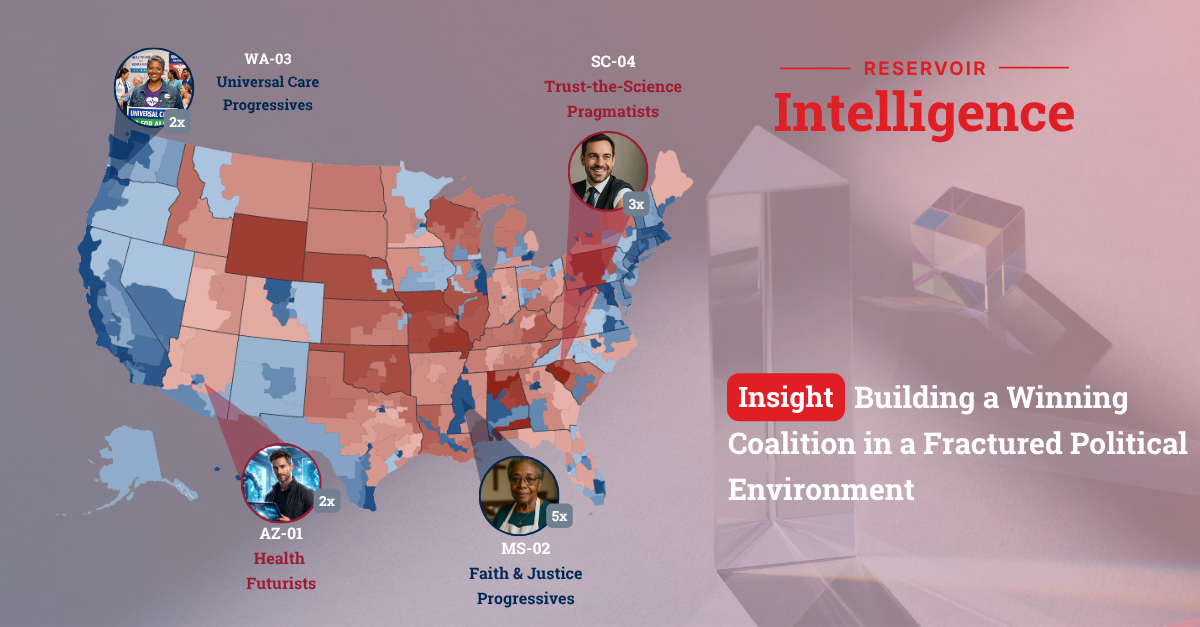
Two Republican districts: Lubbock, Texas (TX-19) and Greenville-Spartanburg, South Carolina (SC-04) are both consistently Republican but respond to different messages.
Lubbock has nearly four times the national concentration of “Consumer Empowerment Champions” – one of PRISM’s 10 Republican audience segments. They believe health care should operate more like a consumer marketplace and prioritize patient choice, transparency and control. They are especially receptive to messages about empowering patient decision-making.
Greenville-Spartanburg, by contrast, has emerged as one of the Southeast’s fastest-growing manufacturing and life sciences corridors. Key audiences here, like those we’ve identified as “Trust-the-Science Pragmatists,” are likely to find science, evidence-based innovation and access to rural health care most compelling.
Two Democratic districts: Seattle, Washington (WA-07) and Jackson, Mississippi (MS-02) both consistently elect Democrats but represent different health care coalitions.
Seattle has long been a bastion of progressive politics – a trend reflected in its exceptionally high concentration of “Universal Care Progressives” – one of PRISM’s 6 Democratic audience segments. They strongly support universal, single-payer health care and respond best to messages about expanding access and systemic reform.
By contrast, Jackson and the surrounding Mississippi Delta reflect a different Democratic coalition. This district has nearly five times the national concentration of “Faith & Justice Progressives.” Their views are shaped by faith communities and lived health disparities, and they are especially persuaded by fairness, equity and affordability.
Two swing districts: Scottsdale, Arizona (AZ-01) and southwestern Washington (WA-03) are both closely contested. But they aren’t simply “moderate” districts. Looking closer reveals that they have different fault lines and sources of common ground.
Scottsdale has roughly twice the national concentration of both Democratic “Health Care Incrementalists” and Republican “Health Futurists” – a distinctly suburban mix of audiences that share a desire for progress but differ over how fast it should happen. Messages that balance progress with practicality and proven benefits to patients are most likely to resonate with these voters.
Southwestern Washington is home to a high concentration of Democratic “Universal Care Progressives” alongside Republican “Wellness Evangelists” – an audience focused on prevention, healthy lifestyles and personal responsibility. Both share a commitment to healthier communities, but “Universal Care Progressives” look to public institutions and policy to drive progress, while “Wellness Evangelists” place that responsibility with individuals and families.
The key takeaway:
How a district votes doesn’t paint the full picture. Effective audience engagement starts with understanding the values and belief systems that drive the audiences within a district.
Turning insights into action:
PRISM turns district-level audience intelligence into actionable strategy and direct activation. These insights can help organizations:
Prioritize districts: Identify the audiences most likely to be mobilized on your issue and where those key audiences are most concentrated.
Tailor communications: Align messages with the values and belief systems most likely to resonate among priority audiences.
Activate key audiences: Reach priority audiences directly through precision targeting, delivering tailored messages to the voters and influencers most likely to engage.
Go deeper:
Click here to explore the PRISM district map, including the audience segments shaping health care opinions in these congressional districts.
Bryan Dumont
Jack Holdsworth
Aug 13, 2026
THE CHALLENGE
Traditional audience definitions often miss the deeper belief systems that determine whether a health message is persuasive or ignored. A campaign may know an audience's age, geography, diagnosis, or political affiliation and still fail to understand how that audience will respond.
How PRISM helps
PRISM is an audience intelligence platform designed to help health care organizations reach the audiences that matter most. It identifies 16 distinct health care audience segments, each shaped by an ideological and belief profile that influences how people receive, interpret, and act on health information.
What PRISM can do
Message testing
PRISM helps identify which messages, proof points, frames, and language are most likely to resonate with specific health care audience segments.
Influence mapping
PRISM maps priority audience segments and the influence networks around them, helping clients understand which voices, messengers, organizations, and pathways can shape perception and move audiences toward action.
Audience activation
PRISM translates insight into activation by supporting precise paid media targeting and stakeholder engagement. Audience files and segment-based guidance help teams reach the right people with the right message.
Insights and monitoring
PRISM uses custom-built social panels and monitoring approaches modeled around health care audience segments to track conversations, sentiment, and emerging risks.
How teams use PRISM
Public affairs teams use PRISM to develop research-backed messaging and activation strategies for policy audiences, voters, stakeholders, and influencers.
Brand and commercial teams use PRISM to understand how political, cultural, and ideological dynamics influence product engagement, disease understanding, and receptivity to innovation.
Corporate communications teams use PRISM to strengthen positioning by identifying messages that reinforce trust, value, reputation, and confidence.