Perspectives on the forces shaping health
Reservoir Health experts share analysis and ideas on the dynamics shaping health care decisions.

Reservoir Health experts share analysis and ideas on the dynamics shaping health care decisions.
Health care decisions are shaped by policy, evidence, trust, market dynamics, public debate, and individual experiences of patients and stakeholders. We share our perspectives to help leaders make sense of those forces and identify what to do next.
Reservoir Communications Group Rebrands as Reservoir Health, Reflecting Breadth of Health Care Expertise & Capabilities
New identity reflects firm’s integrated capabilities across policy, market enablement, and communications with a dedicated focus on helping health innovation reach patients
WASHINGTON, D.C., September 2, 2026 — Reservoir Communications Group today announced that it is now Reservoir Health, a new brand that reflects the firm’s longstanding focus on health care and expanded capabilities to help innovators shape policy, communications and market environments in support of patient access.
“Health care has always been our North Star, and our new brand reinforces our deep subject matter expertise and experience working across the health system and the innovation lifecycle to deliver creative, data-driven solutions that support patients,” said Robert Schooling, Reservoir Health Founder and President. “Our growth and expansion in policy, market enablement, and communications over the last decade has allowed us to serve as our clients’ ‘go-to’ for their most complex challenges and issues.”
Since its founding in 2014, Reservoir Health has grown from a public affairs and communications firm into an integrated strategic advisory firm for health care innovators. Its team brings experience from across the health system—including government, politics, media, patient advocacy and care delivery—and serves innovative life sciences and health care companies, trade associations and nonprofit organizations.
In November 2024, Reservoir Health announced an investment partnership with Periscope Equity, a Chicago-based private equity firm that partners with founder-owned, technology-enabled business services companies. The partnership between Reservoir Health and Periscope has focused on accelerating the firm’s growth and scale while broadening the firm’s capabilities in support of existing and new clients.
Reservoir Health’s expanded model is further strengthened by its recently announced acquisition of Applied Patient Experience, LLC (AppliedPX), a leading patient engagement and patient-centered research consultancy. The combination introduces a fully integrated patient evidence capability to Reservoir’s existing work across policy, communications and market readiness and positions the firm to help clients translate patients’ lived experience into decision-grade evidence that informs clinical development, regulatory strategy, market access, and patient and provider adoption.
Reservoir Health’s work is underpinned by its research team which delivers strategic insights and a clear roadmap for engagement through advanced qualitative and quantitative platforms, including our proprietary PRISM model.
To learn more about the Reservoir Health team, click here. For Reservoir Health Insights, click here.
Reservoir Health is a leading health care consultancy that helps innovators anticipate and shape the environments—policy, communications, and market—that determine which innovations reach patients. Based in Washington, D.C., the firm brings decades of experience across the health system, government, media, and patient advocacy to deliver integrated, data-driven solutions to health care’s most complex challenges.
.png)
More than 66 million Americans live in rural communities, where access to care depends on far more than insurance coverage. Long distances, workforce shortages, limited broadband and transportation, and hospital and pharmacy closures can delay everything from routine screening to specialized treatment.
Rural health is a critical test of whether policy delivers care patients can actually obtain. State policymakers influence that access through Medicaid, state-regulated commercial insurance, and state employee health plans. As the 2027 legislative sessions approach, several issues will challenge their ability to turn policy commitments into practical improvements.
Rural Americans face worse outcomes and a fragile care infrastructure.
Rural residents are more likely than urban residents to die prematurely from heart disease, cancer, stroke, respiratory disease, and unintentional injuries. The CDC estimates that tens of thousands of these deaths may be preventable. Provider shortages and closures make these conditions harder to prevent, diagnose, and treat.
Policymakers must protect the resources that sustain rural care while ensuring they benefit patients. The 340B Drug Pricing Program, for example, can support eligible rural hospitals, but its savings do not automatically lower patients’ costs. The challenge is balancing financial support for local services with transparency and accountability for how those savings improve access.
Access begins long before treatment.
Covered treatments offer little benefit to patients who are never screened, diagnosed, or connected to a provider. Rural access therefore starts with primary care, prevention, and timely diagnostic testing.
Complex chronic conditions, including cancer, Alzheimer’s disease and cardiometabolic care, reflect this challenging dynamic. Biomarker testing can help identify patients likely to benefit from targeted therapies, while emerging blood-based tests offer new possibilities for early detection.
State coverage policies for biomarker testing are expanding, with opportunities to address additional conditions. Yet rural patients may still struggle to reach testing facilities and specialists. These laws also vary in which plans and tests they cover and what utilization management they permit. Policymakers must consider how prior authorization, appeals, cost-sharing, and provider availability affect whether patients receive timely testing.
Coverage does not automatically create access.
A medication can appear on a formulary yet remain difficult to obtain because of prior authorization, step therapy, or coverage changes that prompt non-medical switching. Patients may face paperwork, additional treatment trials, and appeals before receiving their prescribed therapy.
Immunology provides a clear example. A study of 17 large commercial health plans found that, across the medications studied, an average of 78.6% of plans restricted psoriasis coverage beyond the FDA label; for psoriatic arthritis, the figure was 66.8%. Medications were most commonly covered as second-line treatments. Not every restriction is inappropriate, but these findings show why formulary coverage alone is an incomplete measure of access.
Within the insurance markets they regulate, state legislators can establish timely authorization standards, workable step-therapy exceptions, and continuity-of-treatment protections. These measures can help patients obtain clinically appropriate care without avoidable delays.
Policy choices can reduce or deepen rural disparities.
The federal budget legislation enacted in 2025 will put Medicaid at the center of state debates in 2027. New eligibility requirements and financing changes will force difficult choices about coverage, services, and provider payments. More frequent eligibility reviews and work requirements for certain adults also create a risk that eligible patients will lose coverage because of paperwork barriers.
Lawmakers will need to weigh additional Medicaid funding against competing budget priorities. Reducing services or provider payments could make care harder to obtain, while underfunding eligibility systems and enrollment assistance could increase coverage losses. Their budget decisions will shape both who remains insured and whether providers can continue serving them.
Rural health presents a major policy and advocacy opportunity.
The federal Rural Health Transformation Program will direct $50 billion to states from 2026 through 2030, supporting investments in prevention, chronic disease management, workforce, technology, and new care delivery models.
Stakeholders can help shape funding priorities, implementation, and measures of success. Their involvement can keep state decisions grounded in patients’ needs across prevention, diagnosis, treatment, and follow-up care.
The test for 2027 is whether these decisions make timely, effective care easier to obtain. How states meet that challenge in rural communities will offer an early indication of whether broader health policy is improving access in practice.
.png)
Health care organizations have more data than at any point in history. Claims data, electronic health records, patient-reported outcomes, and real-world evidence have transformed our ability to understand what happens within the health care system. Yet patients continue to delay diagnosis, abandon treatment, and disengage care for reasons that often remain invisible. The challenge isn't a lack of data; it's understanding what happens outside the health care system, before a patient ever enters care or after they quietly fall out of it.
That challenge was the focus of the 2026 Reservoir Advocacy and Alliance Network (RAAN) annual convening, where Reservoir’s network of experts and strategic partners explored emerging approaches to advancing patient access. The RAAN brings diverse perspectives and thoughtful insight to some of today's most pressing health challenges, while providing strategic counsel that supports Reservoir's commitment to reducing health disparities and expanding opportunities for better health.
This year’s conversation reinforced that barriers to health care access extend far beyond affordability. Participants noted that while claims and utilization data can show what blocked access, understanding the reason why requires a deeper dive into patients’ lived experiences including trust, stigma, cultural factors, health literacy, and competing responsibilities.
Uncovering The “Why” in Patients’ Experiences
The discussion featured Patient Access Pathways, a tool that addresses the “why.” Patient Access Pathways is Reservoir's proprietary survey and analytics methodology for uncovering access and affordability barriers from the patient's point of view. It uncovers complex and often invisible barriers that influence whether people seek screening, enter care, start treatment, and remain engaged throughout their care journey.
RAAN members pointed to Patient Access Pathways’ ability to change the way they view barriers to patient care, which for many is primarily through a financial lens. One member pointed to the fact that “it is easier to define issues of cost [and] issues of physical access than it is to think about things like emotional, cultural and logistical barriers.” But uncovering those less apparent barriers can shed critical insights into the patient journey.
Going Deeper to Improve Patient Access
RAAN members also emphasized the importance of understanding whether patients have access to health information, as well as what factors motivate them to act on it. Exploring patient perspectives and beliefs can better inform why some individuals do not seek care even when they have perceived access. To this point, members of the RAAN highlighted the value of trusted health messengers and adequate health literacy education to connect with populations that are not effectively served by broader campaigns and messaging.
The discussion also raised the importance of examining access through specific patient populations. For example, people who are uninsured, underinsured, enrolled in Medicaid, or covered through an employer may encounter very different challenges. RAAN members raised prior authorization as one specific example: even after successfully reaching a provider and receiving a diagnosis and prescription, patients may face complicated approval processes and may not know how to challenge a denial or request an exception. Taking the holistic patient experience into consideration helps inform solutions for populations that often face the greatest barriers to care, including people living with rare diseases, marginalized patient communities, veterans, and individuals with disabilities.
This year’s RAAN convening demonstrated that health care access is not defined by a single barrier or moment in the patient journey. Understanding why gaps in care persist requires looking at patients’ lived experiences alongside traditional health care data.
.png)
Companies invest considerable resources in being liked, respected, and trusted. These are worthy ambitions, but on their own they may not offer companies sufficient specificity to build a proactive corporate reputation plan. They don’t answer the question of what a company should actually do.
Reservoir’s value model begins with a practical question: How does your company create value for the people whose decisions matter to its success?
Brand and reputation are often used interchangeably. A brand encompasses a broad range of associations, both cognitive and emotional. Reputation is more specifically what people think of your company based on their understanding of its conduct and contributions.
That distinction matters because reputation programs are often built around broad goals like increasing trust, without defining what a company needs to do to earn it.
Understanding what stakeholders value gives a company a better basis for choosing where to invest. It also makes research more useful. A company may discover that people do not recognize the benefits it delivers, or that the benefits it emphasizes matter less than management assumes. Sometimes, the company simply needs to improve what it does.
Each finding calls for a different response.
An approach rooted in value connects reputation work to business priorities. A pharmaceutical company needs to understand what patients, clinicians and those paying for care value about its work, and where they see shortcomings. Those judgments affect the company’s ability to bring treatments into use and build support for future innovation.
The challenge is to communicate consistently while recognizing that stakeholders have different priorities. Helping people manage illness might mean greater independence to a patient, better treatment options to a clinician and fewer costly complications to a payer. These benefits can support the same corporate story, with evidence that matters to each audience.
Emotional storytelling can help people understand why those benefits matter. But a strong initial response to a story does not establish a lasting change in how people view the company. Reputation is built when the company continues to demonstrate that value through its communications, its decisions and, ultimately, people’s experience with it.
That is why reputation work belongs close to the business. Much of the work involves helping people understand contributions they have overlooked or taken for granted. It also requires knowing the business well enough to recognize when performance needs to improve and being candid about what the company needs to do.
Reputation is built by creating value that matters to the people important to the success of the business, demonstrating and communicating that value consistently, and improving where the company falls short. Understanding what stakeholders value is where that work begins.

Over the last decade, advocacy has evolved.
While ultimate success may still be passing a favorable bill, preventing a harmful policy from advancing, or influencing a regulatory decision, the path to the result has changed.
Increasingly, organizations recognize that policy decisions are shaped long before a vote is cast or guidance is issued. Evidence generation, patient engagement, coalition building, stakeholder relationships, and communications all influence how issues are understood and ultimately how decisions are made. Advocacy brings these disciplines together to shape the policy environment.
Organizations that invest early in relationships, evidence, and infrastructure are better prepared to advance their priorities as Washington changes.
The same is true at the state level, where legislative sessions move quickly, and stakeholders may not recognize a policy’s implications until implementation is underway. Major policy shifts, from Medicaid changes to new coverage requirements, ripple across providers, patients, employers, and health plans.
An integrated approach creates stronger advocacy
Organizations today are increasingly asking not only What policy outcome do we want? but What conditions need to exist for that outcome to become possible?
That means ensuring evidence answers policymakers’ questions, engaging stakeholders to test assumptions, aligning coalition partners, and developing communications that support policy objectives. These efforts are most effective when they inform one another.
Why Reservoir Health
Our new name reflects this integrated approach.
For years, we've helped clients connect policy, communications, stakeholder engagement, and evidence.
We help organizations shape the broader policy and stakeholder environment surrounding the issues that matter most. By bringing these capabilities together, we help clients anticipate change, build alignment, and advance their policy objectives.

Congressional debate often reduces a policy’s fiscal impact to one number: how much it is expected to save or cost over ten years.
That number can determine whether legislation advances, how it is designed and how stakeholders advocate for or against it.
But a score is not a fixed prediction. It is an estimate based on the policy language, available evidence and assumptions about how stakeholders will respond.
Recent Congressional Budget Office (CBO) revisions involving Medicare drug policy show why these estimates are becoming more difficult to produce and why understanding what sits behind the headline number is increasingly important.
Why it matters: The score can shape the policy
CBO scores influence whether a proposal is considered politically and procedurally viable, which provisions are changed or removed, what offsets lawmakers need and how stakeholders frame the policy’s potential benefits and tradeoffs.
The challenge is that health policies rarely operate in isolation. A change in one part of Medicare can alter incentives and behavior elsewhere, sometimes in ways that cannot be fully anticipated before implementation.
A score may be a critical input into policy and advocacy strategy, but the number alone does not reveal which assumptions drive the result, where uncertainty is greatest or where unintended consequences may emerge.
Zooming in: Two recent revisions, two sources of uncertainty
Technical details can change the estimate
In July 2025, CBO estimated that changes to the Inflation Reduction Act’s (IRA’s) orphan-drug exemption would increase federal spending by $4.9 billion over ten years.
After outside experts raised questions about additional products that could be affected, CBO conducted further analysis and revised the estimate to $8.8 billion. CBO also found that the cost could range from $6.7 billion to $10.9 billion, depending partly on how the Centers for Medicare & Medicaid Services (CMS) treats different formulations of affected products.
What this shows: Understanding a proposal’s effects requires more than interpreting its statutory language. It also requires detailed knowledge of the products, programs and markets the policy would affect.
The market may respond differently than expected
In 2022, CBO estimated that the IRA’s major Medicare Part D drug provisions would reduce federal deficits by $129 billion through 2031. CBO now projects that those provisions, taken together, will increase deficits over the same period because:
What this shows: Policy can change behavior throughout the health care system: patients may use more medicines when out-of-pocket costs decline, plans may adjust bids, formularies and utilization management, and manufacturers may change pricing and market strategies. These effects are difficult to isolate and even harder to predict before a policy takes effect.
The takeaway: One score is not enough
The lesson is not that scoring has become less useful. Rather, a single point estimate may provide false precision when a policy depends on uncertain implementation decisions and behavioral responses.
A more decision-useful analysis should identify:
Instead of relying on one estimate, policymakers and stakeholders should examine a central scenario alongside credible higher- and lower-impact scenarios. Sensitivity analysis can show how the result changes when critical assumptions shift.
The goal is not to predict the future with perfect accuracy. It is to understand the conditions under which a policy is likely to achieve its objectives and where it could produce unintended consequences.
From scoring to strategy
CBO-style scoring can inform strategy well beyond the headline budget impact.
A thoughtful analysis can help stakeholders identify major cost drivers, test policy modifications, anticipate questions from policymakers, strengthen the evidence supporting a proposal and prepare for alternative implementation approaches.
It can also support advocacy messages that acknowledge uncertainty while clearly explaining the policy’s rationale and likely effects.
The bottom line
As health policies become more interconnected, scoring them will become more difficult. That makes rigorous analysis more important, not less.
The most useful CBO-style analysis connects the number to the policy choices behind it. It considers multiple plausible scenarios, makes uncertainty visible and gives policymakers and stakeholders a stronger foundation for deciding how to design, defend or improve a proposal.
Go deeper:
To learn more about Reservoir's CBO-style scoring and other analytical capabilities, contact Ashley Flint at aflint@reservoirhealth.com.

Life sciences companies have always invested years preparing for launch. Commercial strategy, medical affairs, market research, pricing, and sales readiness have long been essential ingredients of a successful product introduction.
But over the past two decades, the definition of launch readiness has expanded.
Today, commercial success depends on far more than executing a strong launch plan. Increasingly, it depends on whether the broader health care environment is ready for innovation. Can eligible patients be identified? Do clinical pathways support adoption? Has the right evidence been generated, including patient-reported outcomes and patient experience evidence, to inform value, access, and adoption decisions? Do reimbursement policies create access, or barriers? Are providers, patients, employers, and advocacy organizations aligned around the unmet need the product addresses?
These questions, and the evidence needed to answer them, don't belong neatly to one function. They sit at the intersection of commercial strategy, market access, medical affairs, public policy, patient engagement, and communications.
That's why market enablement has become such an important discipline, and why it looks different at every organization. In some companies, it's led by commercial teams. In others, by public affairs, market access, or medical affairs. Regardless of where it sits, its purpose is the same: understanding the broader forces that will determine whether innovation can achieve its full impact.
At Reservoir Health, we've come to think of this as shaping the market environment.
That means connecting insights that too often live in silos. Understanding how policy influences access. How clinical, economic and patient evidence shapes value discussions. How patient-reported outcomes and lived experience inform adoption, access and stakeholder decision-making. How communications, advocacy, and stakeholder engagement reinforce one another. And how these dynamics continue to evolve throughout a product's lifecycle, not just in the months surrounding launch.
This integrated perspective is also one of the reasons our new name matters.
As Reservoir Health, we're reflecting what we've become: a firm that brings together policy, communications, advocacy, research, and market strategy to help organizations shape the conditions for success. Because preparing a product for launch is only part of the challenge. Increasingly, organizations also need to prepare the market.
Today, I’m proud to share that Reservoir Communications Group is now Reservoir Health.
Our new name reflects the company we have become, the work we have long been doing, and our ambition for the future. Most importantly, it gives clients a clearer picture of the partner we are today.
When I founded Reservoir more than a decade ago, it was with a simple promise: to approach problems from multiple angles and go deep with our clients on their most pressing challenges and opportunities. That ethos continues.
Since then, the pace of scientific innovation has accelerated, but turning that progress into meaningful access and outcomes for patients has become more challenging. Health care decisions are shaped by a broad and interconnected group of policymakers, regulators, payers, providers, patients, advocates, and employers. Expectations for evidence, affordability, and meaningful patient engagement have grown. At the same time, public understanding and trust have become more consequential and harder to earn.
In this environment, policy and regulatory decisions shape access. Communications influence how evidence and intent are understood. Advocacy brings patient and stakeholder priorities into the process. Market-shaping strategy helps determine how innovation is positioned, valued, accessed, and adopted. These disciplines cannot operate in silos because the most consequential challenges facing innovators rarely fit neatly within a single function.
A belief in integration has shaped Reservoir from the beginning. We have built deep expertise across policy and advocacy, strategic communications, market enablement and commercialization, research and insights, patient engagement, and patient experience research and evidence, and our growth continues.
That is why we are becoming Reservoir Health. The name more clearly expresses our specialized focus on health care and the integrated way we approach our clients’ most important business, policy, access, and reputation challenges. Clients can continue to come to us for a focused need. They can also draw on a connected, multidisciplinary team when their challenges span functions and environments across the innovation lifecycle.
While our name is changing, the qualities that define Reservoir are not. We remain collaborative, intellectually curious, and committed to exceptional work. Our One Team approach continues to guide how we work across disciplines, build lasting client relationships, and bring the best of Reservoir to every challenge.
This change reflects how far we have come while giving us a stronger foundation for where we are headed.
Our clients need partners who can see the whole landscape: the policy environment, the narrative environment, and the market environment. They need strategies that connect those worlds and teams capable of turning complexity into practical action.
That is the future we are building at Reservoir Health, and I could not be more excited about what comes next.
You can learn more in our press release and explore our new website at reservoirhealth.com.

Short state legislative sessions are not simply compressed versions of longer ones. They are faster, more crowded, and less forgiving. Bills can move from introduction to committee action in days, while budget negotiations and leadership priorities leave little room for unfamiliar issues. Organizations that wait for the opening gavel to begin educating stakeholders are already behind.
The pressure will be especially intense in 2027, when six states — Florida, Louisiana, Utah, Virginia, West Virginia, and Wyoming — are scheduled to complete their regular sessions in approximately 60 days or less. In these environments, policymaker education, coalition building, and message preparation must begin well before lawmakers convene.
Preparation begins with clarity about the problem, the desired policy outcome, and the forces likely to shape the debate. In a compressed session, evidence must do more than establish credibility; it must make the issue immediately relevant to the state and its priorities. Policymakers need to understand why action is necessary, what is at stake for constituents, and how the issue intersects with fiscal and political realities.
Credible voices are equally important. Clinicians, researchers, community leaders, employers, and patient advocates can translate complex evidence into perspectives that resonate with different audiences. When these leaders are informed, aligned, and ready to engage, they can elevate an emerging concern, counter misinformation, and give decision-makers greater confidence in the path forward.
Legislative success also depends on support that extends beyond a single bill sponsor. A durable network of policymakers, agency officials, staff, and outside organizations can create broader ownership of the issue and sustain momentum as priorities shift. The strongest champions do more than endorse a proposal; they help establish its relevance, bring others into the conversation, and position it for meaningful consideration.
In a short session, agility matters, but agility is built through preparation. When the window opens, successful campaigns already have the evidence, voices, visibility, and champions needed to move.
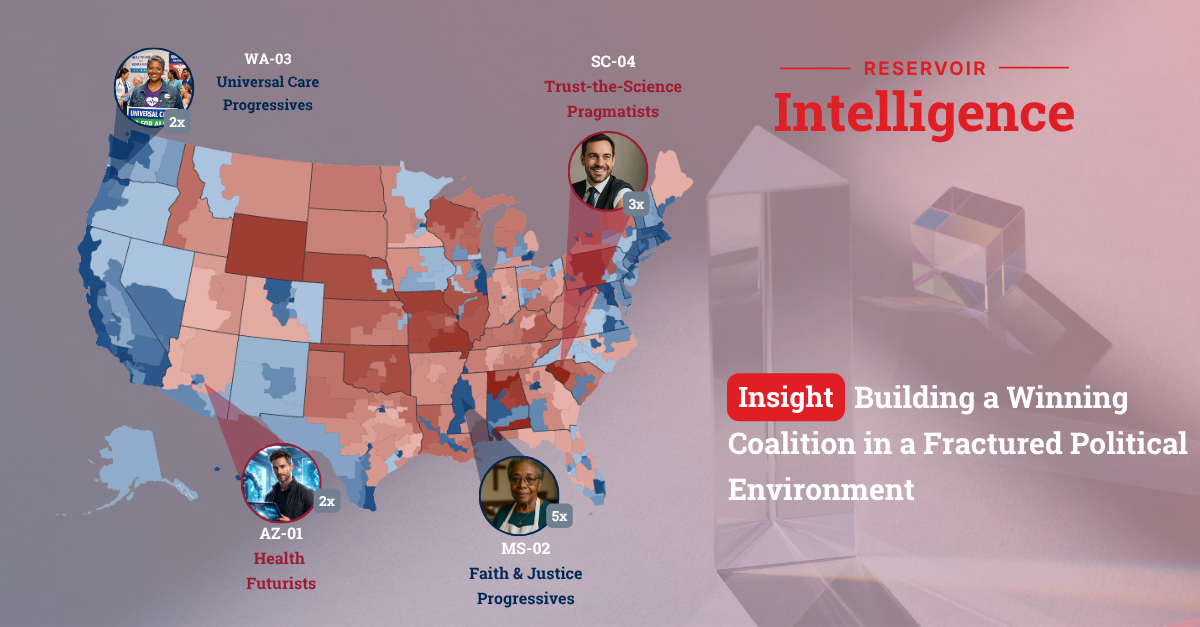
As the midterms approach, communicators must increasingly look beyond broad labels like “Republican,” “Democratic” or “swing” to the values and belief systems that shape how audiences think about health care.
Using PRISM, Reservoir’s audience intelligence platform, we mapped all 435 congressional districts across 16 behavioral and ideological audience segments.
Audiences in districts with similar voting patterns can have very different views on health care – requiring different engagement strategies. For example:
How a district votes doesn’t paint the full picture. Effective audience engagement starts with understanding the values and belief systems that drive the audiences within a district.
PRISM turns district-level audience intelligence into actionable strategy and direct activation. These insights can help organizations:
Click here to explore the PRISM district map, including the audience segments shaping health care opinions in these congressional districts.