Perspectives on the forces shaping health
Reservoir Health experts share analysis and ideas on the dynamics shaping health care decisions.

Reservoir Health experts share analysis and ideas on the dynamics shaping health care decisions.
Health care decisions are shaped by policy, evidence, trust, market dynamics, public debate, and individual experiences of patients and stakeholders. We share our perspectives to help leaders make sense of those forces and identify what to do next.
Reservoir Communications Group Rebrands as Reservoir Health, Reflecting Breadth of Health Care Expertise & Capabilities
New identity reflects firm’s integrated capabilities across policy, market enablement, and communications with a dedicated focus on helping health innovation reach patients
WASHINGTON, D.C., September 2, 2026 — Reservoir Communications Group today announced that it is now Reservoir Health, a new brand that reflects the firm’s longstanding focus on health care and expanded capabilities to help innovators shape policy, communications and market environments in support of patient access.
“Health care has always been our North Star, and our new brand reinforces our deep subject matter expertise and experience working across the health system and the innovation lifecycle to deliver creative, data-driven solutions that support patients,” said Robert Schooling, Reservoir Health Founder and President. “Our growth and expansion in policy, market enablement, and communications over the last decade has allowed us to serve as our clients’ ‘go-to’ for their most complex challenges and issues.”
Since its founding in 2014, Reservoir Health has grown from a public affairs and communications firm into an integrated strategic advisory firm for health care innovators. Its team brings experience from across the health system—including government, politics, media, patient advocacy and care delivery—and serves innovative life sciences and health care companies, trade associations and nonprofit organizations.
In November 2024, Reservoir Health announced an investment partnership with Periscope Equity, a Chicago-based private equity firm that partners with founder-owned, technology-enabled business services companies. The partnership between Reservoir Health and Periscope has focused on accelerating the firm’s growth and scale while broadening the firm’s capabilities in support of existing and new clients.
Reservoir Health’s expanded model is further strengthened by its recently announced acquisition of Applied Patient Experience, LLC (AppliedPX), a leading patient engagement and patient-centered research consultancy. The combination introduces a fully integrated patient evidence capability to Reservoir’s existing work across policy, communications and market readiness and positions the firm to help clients translate patients’ lived experience into decision-grade evidence that informs clinical development, regulatory strategy, market access, and patient and provider adoption.
Reservoir Health’s work is underpinned by its research team which delivers strategic insights and a clear roadmap for engagement through advanced qualitative and quantitative platforms, including our proprietary PRISM model.
To learn more about the Reservoir Health team, click here. For Reservoir Health Insights, click here.
Reservoir Health is a leading health care consultancy that helps innovators anticipate and shape the environments—policy, communications, and market—that determine which innovations reach patients. Based in Washington, D.C., the firm brings decades of experience across the health system, government, media, and patient advocacy to deliver integrated, data-driven solutions to health care’s most complex challenges.

Election years don’t just change who’s in office. They reshape the environment in which health care advocacy organizations pursue their missions. The 2026 midterm elections will influence congressional leadership and committee priorities, state policy agendas, and the broader health care landscape. Organizations that prepare now will be better positioned to protect patient access, advance key policy priorities, and build relationships with policymakers before and after Election Day.
Effective advocacy, particularly when advancing a policy agenda, is about becoming a trusted resource when policymakers need timely, credible information to make informed decisions. That’s why the strongest advocacy programs don’t simply react to political change; they anticipate it by investing early in the relationships, resources, and infrastructure needed to remain effective regardless of how the political landscape evolves.
Now is the time to pressure test your internal and external advocacy strategy by:
Election Day is an important milestone, but it isn’t the finish line. In many ways, the most meaningful work begins once the ballots have been counted, and the governing landscape begins to take shape.
Changes in leadership, committee assignments, agency priorities, and legislative calendars can quickly reshape the policy environment. Taking the time now to prepare for multiple scenarios will better position your organization to maintain momentum, adapt to change, and continue advancing their mission regardless of the political landscape.
That preparation starts with asking a few critical questions. Does your organization have the resources needed to educate new audiences about your issue? Are your messaging, materials, and policy priorities flexible enough to remain relevant as priorities shift? Have you identified where your strongest relationships exist — and where you’ll need to build new ones?
The transition period post-election moves quickly, leaving little time to develop new strategies from scratch. Think of the time between November and January as an opportunity to reaffirm coalition alignment, ensuring partners remain unified around shared priorities, consistent messaging, and a coordinated strategy as the policy landscape evolves. Organizations that pressure-test their advocacy plans before Election Day won’t spend the transition reacting — they’ll spend it leading.
As the midterms approach, take the opportunity to refresh your advocacy resources — from fact sheets to issue briefs — with the latest data and policy developments. Just as importantly, distill that information into concise, decision-ready resources that help policymakers quickly understand both the challenge and the solution.
Importantly, consider how your materials are framed for your audience(s). The most compelling and impactful advocacy campaigns align policy solutions and patients together. No matter the complexity of the issue, authentic stories that reflect patients’ lived experiences are one of the most important ways to turn abstract policy debates into conversations that drive awareness, understanding, and action.
As you evaluate your advocacy infrastructure and materials, determine whether your messaging strikes the right balance between evidence and experience. Do your materials pair credible data with compelling patient stories? Are patient voices woven throughout your communications? Every advocate should be able to explain not only the policy challenge, but the real-world consequences of getting it right — or wrong — for the patients and communities elected officials represent. Relatedly, your outreach to advocates should be intentional and clear. Strong two-way communication is essential at every step of your advocacy efforts.
Building and empowering your advocates is key ahead of and during transitions, and they ultimately represent your organization in more places than ever before. Whether they’re meeting with policymakers, participating in coalition meetings, speaking at conferences, engaging with reporters, or mobilizing grassroots supporters, every interaction reinforces — or weakens — your organization’s credibility. Organizations that invest in shared messaging and consistent training create advocates who speak with one voice, regardless of the audience.
The post-election environment will also usher in new lawmakers and staff who may have little familiarity with your issue. That makes this the ideal time to prepare your advocates — not only by sharpening their storytelling skills, but by ensuring they can confidently educate new audiences, answer difficult questions, and establish themselves as trusted resources from the very first meeting. Whether you’re onboarding first-time grassroots advocates or preparing seasoned champions for a new Congress, investing in advocacy training today will strengthen every engagement tomorrow.
Election years reshape the environment in which advocacy organizations operate. The organizations that succeed won’t be those that predicted every outcome — they’ll be the ones that invested in the people, partnerships, and infrastructure needed to thrive in any environment. The question isn’t whether change is coming. It’s whether your advocacy program is ready to lead through it.

Patient-centered evidence is playing an increasingly important role in health care decision-making. Regulators, health technology assessment (HTA) bodies, payers and employers are seeking a more complete understanding of how disease and treatment affect patients' lives, alongside traditional measures of clinical benefit.
This shift is evident across the health care ecosystem.
The FDA's Patient-Focused Drug Development initiative and Benefit-Risk Framework encourage regulators to consider patient experience data when they make decisions about new drugs. HTA organizations around the world increasingly include patient evidence and input in value assessments. Payers and employers are also looking beyond traditional clinical endpoints to better understand treatment burden, quality of life and outcomes that matter most to patients.
Why it matters:
The challenge is that most organizations still generate patient-centered evidence on a study-by-study basis. While individual studies provide valuable insights, they rarely provide a full picture of what is known, what evidence is missing or what will be needed to support future decisions.
Zooming in:
We use a Patient Experience Dossier (PE Dossier) framework to address this challenge.
A Patient Experience Dossier organizes patient-centered evidence around the aspects of disease and treatment that matter most to patients and are most relevant to health care decision-making. This may include burden of disease and unmet need, treatment experiences, patient preferences, meaningful outcomes and barriers to access and care.
By bringing these domains together in a single, decision-oriented resource, organizations can identify where more evidence is needed across each step of patient journey, in different markets and on key patient experience topics. It can then map those evidence gaps to the decisions they are intended to inform throughout the product lifecycle.
Rather than creating a separate workstream, the dossier becomes the foundation for both evidence planning and evidence generation.
Evidence Planning & Strategy. The first step is to assess the patient-centered evidence that is already available and identify evidence gaps.
Evidence Generation. The next step is to fill important evidence gaps.
Bottom Line:
A Patient Experience Dossier is more than a summary of existing evidence or a traditional evidence gap assessment. It is a strategic planning framework that organizes patient-centered evidence around the aspects of disease and treatment that matter most to patients.
It also connects evidence gaps to the decisions the evidence is meant to support. This enables organizations to prioritize research investments, avoid unnecessary duplication and ensure patient-centered evidence is available when regulators, HTA bodies, payers, providers and other decision-makers need it.
Go deeper:
We introduced the concept of Patient Experience Dossiers in a Health Affairs Forefront article, describing how these dossiers can help organizations organize patient-centered evidence, identify evidence gaps and support decision-making throughout the product lifecycle.

For millions of workers and their families, employers are a gateway to health care, influencing what benefits are offered, which vendors are selected, which treatments are covered, and how employees access their care. That influence extends far beyond purchasing decisions into areas such as mental health, where parity in coverage (to benefits focused on physical health) is aligning with employer recognition of the impact of mental health on employee wellbeing, organizational culture and engagement, and workplace performance. To meet the moment, health care stakeholders need to engage employers as partners –– together with patients, advocates, and clinical leaders –– so benefit design and coverage policies translate into timely, trusted, and usable mental health care.
Employee experience data highlights the overwhelming need for mental health coverage. According to the 2024 National Alliance on Mental Illness (NAMI) Workplace Mental Health Poll (2024 NAMI poll), half of employees reported feeling burned out because of their job in the past year, and a third said they felt so overwhelmed it affected their ability to work.
Employer leaders are taking action to reflect this priority by elevating mental health benefits into a core component of employer health strategy. In the 2025 Pulse of the Purchaser Annual Survey from the National Alliance of Healthcare Purchaser Coalitions, most employers say they are currently or are considering integrating behavioral health into primary care, signaling the normalization of mental health as part of employers’ overall benefits strategy.
Employers often feel the effects of anxiety, depression, and burnout long before it appears in claims data through absenteeism, presenteeism, reduced focus, strained teams, and rising employee demand for support. They also recognize that benefits offered on paper can remain difficult for employees to understand, access or use –– a finding confirmed by the 2024 NAMI poll reporting that the majority of employees say their employer offers mental health coverage, but most either do not know or are unsure how to access their mental health benefits.
These gaps show why mental health benefits cannot be measured solely by whether coverage exists. Benefits design, workplace culture, and employee communication all shape whether access to mental health services becomes meaningful care.
Additionally, while employers are seeking to provide parity coverage aligned to employee demands, vendor complexity and PBM processes create challenges in knowing whether they are on the right path.
With one-third of employers struggling to get complete claims data, many have limited visibility into whether benefit design and coverage align with employee needs and utilization patterns, and have no way to assess the quality of care and overall cost related to their health care benefits package.
Employers have taken action to incorporate mental health in benefits design, but there is a gap in how to make those benefits practical in addressing rising need, persistent access barriers, and pressure to provide new care options responsibly. The path forward will require stakeholders to engage employers, who bring a distinct perspective to identify where gaps exist, what evidence matters, and how coverage decisions are made.
As employers take a more active role in mental health access, initiatives like Pulse of the Purchaser Research Institute can help connect employer experience with patient, clinical, and policy perspectives.

The One Big Beautiful Bill Act (OBBBA) marks one of the most significant Medicaid policy shifts in years, with implications for state financing, eligibility, provider stability, and patient access. While many provisions will phase in over time, federal agencies and states are beginning to operationalize key provisions.
As federal agencies release ongoing guidance on Medicaid financing programs and work requirements (just to name a few), states are already adjusting in response — creating direct implications for patients, providers, and healthcare companies.
In the coming months and years, these changes will likely reshape how states fund Medicaid, how providers — particularly safety-net and rural providers — sustain and adjust operations, how patients maintain coverage, and how healthcare companies communicate around their Medicaid benefits. Just as importantly, the ripple effects will look different from one state to the next.
Much of the conversation around OBBBA has focused on projected federal Medicaid spending reductions over the next decade. For states, providers, and managed care organizations, however, the more immediate challenge is operational: how to adapt as financing rules, eligibility requirements, and oversight expectations begin to change.
For example, the Centers for Medicare and Medicaid Services (CMS) has begun releasing federal guidance for states on OBBBA’s new restrictions for Medicaid financing arrangements, including recent proposals around changes to state directed payments. Because many states rely on these financing tools to support Medicaid spending and supplemental provider payments, the new restrictions could force difficult tradeoffs elsewhere.
Those pressures are unlikely to fall evenly across the country. States that expanded Medicaid under the Affordable Care Act — especially those that rely heavily on provider taxes or state directed payments — may face greater fiscal strain than others. Some may move quickly to reduce spending, while others may look for ways to preserve coverage and provider stability through alternative financing strategies.
That divergence matters for healthcare companies operating nationally. Hospitals and safety-net providers could face growing strain if supplemental payment programs shrink or reimbursement pressure increases, with rural providers particularly vulnerable. Coverage disruptions and administrative churn could contribute to higher levels of emergency department utilization and uncompensated care. At the same time, biopharma and life sciences companies could face downstream effects from coverage instability, including changes in formulary access, reduced medication adherence, increased demand for patient support programs, and heightened scrutiny around affordability and access.
These pressures are likely to intensify as work requirements, eligibility verification changes, provider tax restrictions, and other changes to the program phase in. For stakeholders across the healthcare industry, the Medicaid landscape may become increasingly state-specific at exactly the moment federal scrutiny is intensifying.
For many patients, the biggest challenge may not be navigating the policy changes themselves, but rather understanding that their coverage status or eligibility requirements have changed at all. Many Medicaid beneficiaries may first learn that their coverage status or eligibility has changed only after missing a renewal notice, arriving at a pharmacy counter without active coverage, or attempting to access care.
Case in point: Experience from prior Medicaid work requirement programs, most notably in Arkansas and Georgia, suggested that eligible beneficiaries often lost coverage because of reporting burdens and administrative barriers rather than substantive ineligibility. As Medicaid expansion states prepare for work requirements and more frequent eligibility checks beginning in 2027, concerns are growing that many patients may lose coverage simply because they do not understand what actions they need to take or when they need to take them.
Communicating changing eligibility requirements, renewal timelines, and work verification rules to millions of Medicaid beneficiaries will be an enormous operational challenge — particularly when serving individuals with unstable housing, limited communication access, or complex health needs.
The next phase of the Medicaid debate will be shaped by how states operationalize federal changes, how patients experience these changes on the ground, and, in turn, how the federal government responds to the real-world impacts of the law.
Several developments will be worth watching closely:
Reservoir helps clients navigate this environment by supporting proactive patient education and awareness efforts, engaging policymakers and healthcare influencers on the future of the program, and developing credible communications strategies around coverage, access, and affordability.
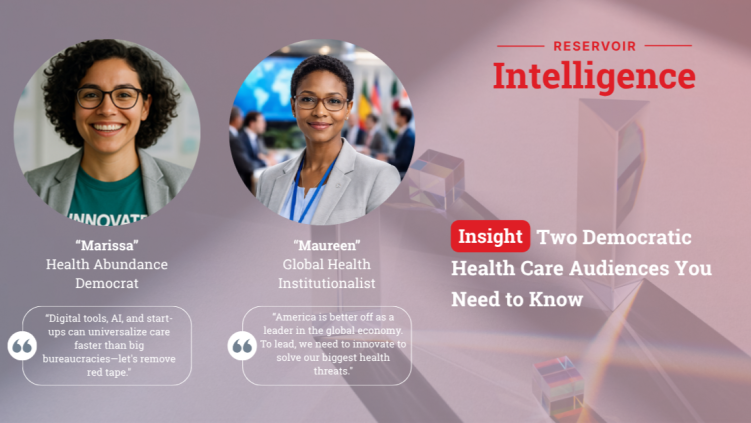
Democratic health care audiences are increasingly fractured – not just by policy preferences, but by deeper beliefs about justice, reform, American leadership and the role of the private sector. For organizations trying to communicate effectively, those differences matter: a message that motivates one audience may fall flat with another.
Zooming in:
Our research has identified six distinct Democratic audience segments – each with their own unique values and belief systems.
This month, we’re spotlighting two Democratic segments that look similar on traditional political measures: Both trust science. Both support innovation. Both favor public investment in health care. Yet they disagree fundamentally about progress. Messages that resonate with one often fall flat with the other.
The unifying thread:
Why they’re different:
Go deeper:
Get in touch to learn more about how PRISM can inform your strategy: prism@reservoircg.com
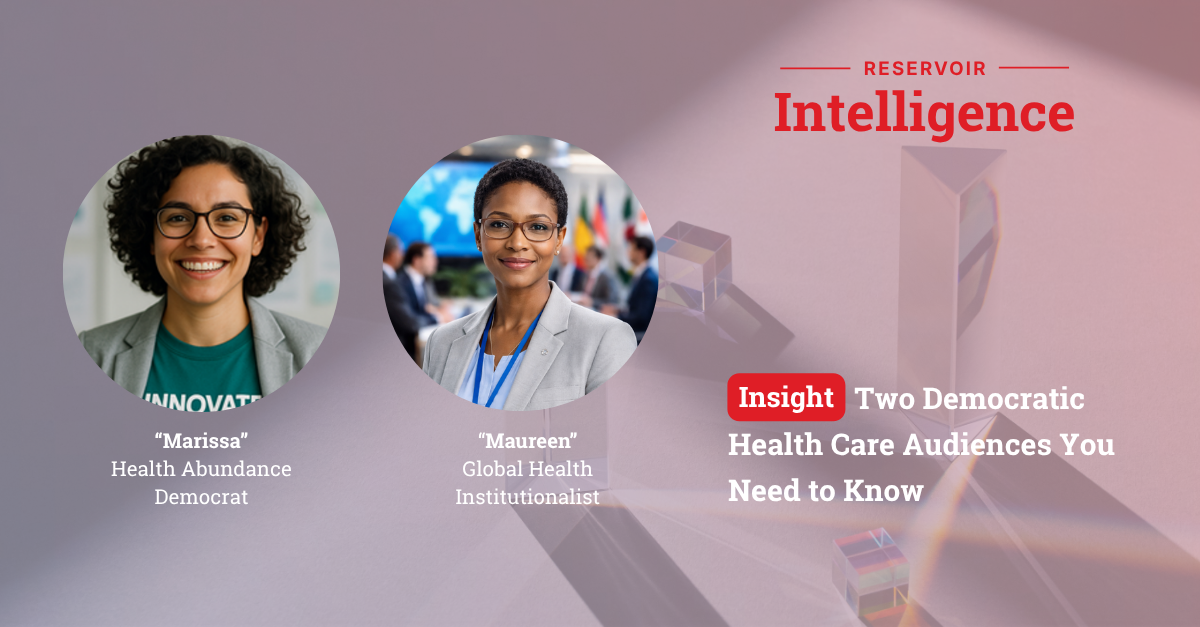
Democratic health care audiences are increasingly fractured – not just by policy preferences, but by deeper beliefs about justice, reform, American leadership and the role of the private sector. For organizations trying to communicate effectively, those differences matter: a message that motivates one audience may fall flat with another.
Our research has identified six distinct Democratic audience segments – each with their own unique values and belief systems. This month, we’re spotlighting two Democratic segments that look similar on traditional political measures: Both trust science. Both support innovation. Both favor public investment in health care. Yet they disagree fundamentally about progress. Messages that resonate with one often fall flat with the other.
Reservoir’s audience intelligence platform, PRISM, maps 16 distinct audience segments across the health care landscape, each with distinct values and belief systems. The Health Abundance Democrats and Global Health Institutionalists are just two of six Democratic segments – each requiring a tailored approach to messaging and engagement. Get in touch to learn more about how PRISM can inform your strategy: prism@reservoirhealth.com

ASCO 2026 underscored a fundamental truth: the future of cancer care depends not only on breakthrough therapies, but also on our ability to identify the patients who can benefit from them.
From lung cancer screening and biomarker testing to AI-assisted diagnostics and technology-enabled workflows, diagnostics were a recurring theme throughout the meeting. Targeted therapy advances reinforced the promise of matching treatments to tumor biology, while discussions around screening, testing, and implementation highlighted a harder question: are health systems optimized to find, test, and route the right patients to the right care?
As precision oncology advances, however, it is becoming clear that the challenge is no longer just scientific innovation. It is the diagnostic pathway itself, encompassing the journey from risk identification and screening to diagnosis, biomarker testing, treatment selection, and access.
Here are our five key takeaways from ASCO:
ASCO highlighted how rapidly targeted therapies are advancing across cancers, including in molecular defined tumor types where treatment decisions depend on timely and appropriate diagnostic testing. Data from LIBRETTO-432 reinforced both the promise of targeted therapies in a deadly cancer and the need for comprehensive biomarker testing across disease stages.
But those innovations only create value if eligible patients are identified, tested, and connected to care. The next challenge is ensuring patients, providers, labs, and payers are aligned to move patients efficiently from diagnosis to treatment.
Lung cancer screening has proven value, but uptake remains low even among eligible populations. Current approaches are still focused on age and smoking history but are limited in their ability to identify patients who may be at risk biologically, as well.
As targeted therapies move earlier in the treatment paradigm, screening approaches focused on age and behavioral risk without accounting for biological risk, will miss critical patient populations. These gaps become more consequential. Future screening and risk identification models will need to become more personalized to fully realize the benefits of early intervention.
This does not mean screening should expand without evidence, but ASCO made it clear that the evidence must evolve if the system and patients are going to fully realize the benefits of early intervention.
The most compelling AI applications at ASCO were not replacing clinicians, but helping the system better identify patients, flag testing needs and streamline care decisions. Success will depend on integrating AI into real-world workflows and ensuring patients can act on the insights it generates.
An ASCO presentation of an AI-assisted lung cancer screening platform showed how valuable this technology becomes when paired with navigation, care coordination, EHR integration, and delivery models. But implementation will matter, particularly understanding who receives and acts on this information, and if follow up care is covered and accessible. Without clear answers, AI risks becoming another layer of noise in an already fragmented system.
New technologies such as AI-enabled biomarkers, ctDNA, and multi-cancer early detection are generating excitement, but adoption will depend on more than technical performance. For diagnostic innovation to scale, providers and patients need confidence that a test will not just detect disease but guide what happens next.
Does it support better treatment? Avoid unnecessary treatment? Enable early intervention? Ensure high-value care? Stakeholders will need answers to these questions to trust the diagnostic and the pathway that follows.
Companies can no longer treat diagnostics as a downstream consideration. Access to testing, provider education, patient navigation, and evidence generation must be incorporated into launch, access, and advocacy strategies from the start.
Stakeholders will need to understand that the value story of a therapy must account for the diagnostic pathway, and that clinical performance is only one part of adoption. Diagnostic access is increasingly synonymous with patient access.
To deliver on the promise of precision oncology, companies bringing new therapies to market must ensure that patients can move seamlessly from screening and diagnosis, to appropriate testing and treatment. That means diagnostic readiness is a prerequisite for both patient access and launch success.
Patient engagement is not new in pharma. For years, companies have invested in patient advocacy, advisory boards, support programs, and storytelling initiatives designed to bring the patient voice closer to decision-making. These continue to be vital elements of patient engagement.
What is changing now is that patient insight is about more than engagement – it is fast becoming a critical form of evidence used to inform regulatory, reimbursement, and access decisions across healthcare.
Regulators are evolving quickly. The FDA’s patient-focused drug development guidance, growing reliance on real-world evidence, and increasing emphasis on outcomes that matter to patients are reshaping expectations around what constitutes meaningful evidence. In Europe, new HTA frameworks are increasing scrutiny on comparative effectiveness, quality of life, and lived experience.
At the same time, healthcare stakeholders want more than traditional clinical trial evidence alone. Payers want proof of real-world value. Providers want evidence that patients can adhere to and benefit from therapies in real-world settings. Patients themselves increasingly expect to be active participants in the development process.
Taken together, these shifts are redefining the role of patient insight in healthcare decision-making.
For much of the past decade, patient engagement often sat adjacent to core development and commercial strategy. Stories created empathy and awareness, but they were rarely treated as decision-grade inputs. Today, that is rapidly changing.
Organizations across the healthcare ecosystem are increasingly expected to operationalize patient insight into evidence that regulators, payers, providers, and biopharmaceutical leaders can act on. The ability to demonstrate lived experience, treatment burden, quality of life, and real-world outcomes is becoming essential to how therapies are evaluated, differentiated, reimbursed, accessed, and adopted.
In other words, patient evidence is becoming table stakes for access and healthcare decision-making.
The organizations that succeed in this next era of biopharmaceutical development will be those that move beyond viewing patient engagement as a communications exercise and instead embed patient evidence across the product lifecycle, combining clinical, real-world, and lived-experience data into a more complete understanding of therapeutic impact.
The future of pharma will not be defined solely by scientific innovation, but by which organizations most effectively translate patient experience into evidence that drives better decisions, stronger outcomes, broader access, and greater trust.
All of this is why I’m particularly excited to share that AppliedPX, a leading patient engagement and patient insights firm, has joined Reservoir. We’re excited to welcome Elisabeth and Joe to our team.
AppliedPX is helping accelerate the shift toward decision-grade patient evidence by translating lived experience into structured, actionable insights that can inform clinical development, market access, engagement strategy, and commercialization. Through Reservoir’s work across policy, communications, and market enablement, patient evidence becomes a critical tool for shaping how therapies are understood, valued, accessed, and adopted.
Together, we look forward to helping ensure that the patient is not only represented in the conversation but embedded in the evidence that drives decisions from innovation through access.
For more information, check out our announcement.
WASHINGTON, D.C. — June 3, 2026 — Reservoir Communications Group today announced the acquisition of Applied Patient Experience, LLC (AppliedPX), a leading patient engagement and patient-centered research consultancy. The combination introduces a fully integrated patient evidence capability to Reservoir’s existing work across policy, communications and market readiness and positions the firm to help clients translate patients’ lived experience into decision-grade evidence that informs clinical development, regulatory strategy, market access, and patient and provider adoption.
Reservoir’s team brings decades of experience working across the health system, national and state politics, government, media, patient advocacy and patient care. Since 2014, Reservoir has continued to expand its reach and expertise across advocacy, corporate communications and market readiness, particularly among innovative life science and health care brands, trade associations and non-profit organizations. In 2024, Reservoir announced an investment partnership with Periscope Equity, a Chicago-based private equity firm that partners with founder-owned, technology-enabled business services companies, to help accelerate Reservoir’s growth and scale.
Founded by Elisabeth M. Oehrlein, PhD, MS, AppliedPX has built a reputation for rigorous, patient-centered research and advisory work with patient organizations, biopharmaceutical companies, trade associations and leading research organizations. The firm’s services span qualitative research and advisory boards, policy research, stakeholder engagement, trainings on collecting and using patient-centered data as well as environmental scans.
“AppliedPX is a leader in decision-grade patient research. Bringing their expertise into Reservoir means we can help clients not only engage with and advocate on behalf of patients, but also embed meaningful patient evidence across the product lifecycle.” — Robert Schooling, President and Founder, Reservoir Communications Group
“Regulators, payers and providers are all demanding evidence that reflects how patients experience innovation and how it addresses unmet needs. Joining Reservoir gives our work a broader platform — connecting patient evidence at every step of the process. Together, we can help ensure the patient is in the driver’s seat from innovation through to access.” — Elisabeth M. Oehrlein, PhD, MS, Founder and CEO, AppliedPX
# # #
Applied Patient Experience, LLC (AppliedPX) is a patient engagement and patient-centered research consultancy that advances the science of patient-focused drug development, value and health technology assessment, and real-world research. AppliedPX partners with patient organizations, non-profits, biopharmaceutical companies, trade associations, and CROs to lead patient-centered research, support patient-focused drug development, train stakeholders, and shape policy. Its proprietary Patient-Centered Evidence in Action (APx-PACE) database helps clients align with evolving regulatory expectations and strengthen patient-focused strategies. AppliedPX is headquartered in Washington, DC, with an additional office in Pittsburgh, PA. Learn more at appliedpx.com.
Reservoir Communications Group, LLC is a leading health care consultancy focused on helping clients address their most important business, advocacy, policy and reputation challenges and opportunities. Learn more at https://reservoircg.com/.
# # #