Perspectives on the forces shaping health
Reservoir Health experts share analysis and ideas on the dynamics shaping health care decisions.

Reservoir Health experts share analysis and ideas on the dynamics shaping health care decisions.
Health care decisions are shaped by policy, evidence, trust, market dynamics, public debate, and individual experiences of patients and stakeholders. We share our perspectives to help leaders make sense of those forces and identify what to do next.
Reservoir Communications Group Rebrands as Reservoir Health, Reflecting Breadth of Health Care Expertise & Capabilities
New identity reflects firm’s integrated capabilities across policy, market enablement, and communications with a dedicated focus on helping health innovation reach patients
WASHINGTON, D.C., September 2, 2026 — Reservoir Communications Group today announced that it is now Reservoir Health, a new brand that reflects the firm’s longstanding focus on health care and expanded capabilities to help innovators shape policy, communications and market environments in support of patient access.
“Health care has always been our North Star, and our new brand reinforces our deep subject matter expertise and experience working across the health system and the innovation lifecycle to deliver creative, data-driven solutions that support patients,” said Robert Schooling, Reservoir Health Founder and President. “Our growth and expansion in policy, market enablement, and communications over the last decade has allowed us to serve as our clients’ ‘go-to’ for their most complex challenges and issues.”
Since its founding in 2014, Reservoir Health has grown from a public affairs and communications firm into an integrated strategic advisory firm for health care innovators. Its team brings experience from across the health system—including government, politics, media, patient advocacy and care delivery—and serves innovative life sciences and health care companies, trade associations and nonprofit organizations.
In November 2024, Reservoir Health announced an investment partnership with Periscope Equity, a Chicago-based private equity firm that partners with founder-owned, technology-enabled business services companies. The partnership between Reservoir Health and Periscope has focused on accelerating the firm’s growth and scale while broadening the firm’s capabilities in support of existing and new clients.
Reservoir Health’s expanded model is further strengthened by its recently announced acquisition of Applied Patient Experience, LLC (AppliedPX), a leading patient engagement and patient-centered research consultancy. The combination introduces a fully integrated patient evidence capability to Reservoir’s existing work across policy, communications and market readiness and positions the firm to help clients translate patients’ lived experience into decision-grade evidence that informs clinical development, regulatory strategy, market access, and patient and provider adoption.
Reservoir Health’s work is underpinned by its research team which delivers strategic insights and a clear roadmap for engagement through advanced qualitative and quantitative platforms, including our proprietary PRISM model.
To learn more about the Reservoir Health team, click here. For Reservoir Health Insights, click here.
Reservoir Health is a leading health care consultancy that helps innovators anticipate and shape the environments—policy, communications, and market—that determine which innovations reach patients. Based in Washington, D.C., the firm brings decades of experience across the health system, government, media, and patient advocacy to deliver integrated, data-driven solutions to health care’s most complex challenges.
Eighteen months into the creation and advancement of our formalized Diversity and Inclusion (D&I) policy and plan at Reservoir, our diversity, equity and inclusion efforts continue to evolve and grow as we work to make our company a more diverse, equitable and inclusive place of business and support system for our local community. Here are a few key takeaways and learnings as we advance efforts forward:
The energy and support to ensure that D&I is both a company-wide and community-wide engagement opportunity remain strong.
The team built on our 2020 progress to expand our recruiting, internal engagement and community support efforts, with a continued hunger to engage on the issues. Some highlights include:
There is a continual opportunity to grow and deepen our efforts; we’re focused on relationship building and learning about where our skills and abilities can provide value.
Our work here is truly an ongoing effort, and we’ve learned that how we continue to advance our impact is aligned with how we do so with our clients – by focusing on partnership and what we do best to deliver results. To that end, some of what we have planned to grow our work includes:
For us, striving to “be the best” means continuing to honor and expand upon our commitment to exemplifying a diverse, inclusive and equitable company. Ultimately, our actions and learnings since implementing our Diversity and Inclusion plan are making Reservoir a stronger company for our employees and our clients, and our work continues.
Since Reservoir’s founding, our team has always prioritized supporting organizations and causes that advance meaningful changes within our communities. This year, to align with our organization’s broader focus on diversity, equity and inclusion (D&I), we’ve focused our efforts on helping underserved communities across D.C. Here are some highlights of our activities over the past year:
Supporting Longstanding Social Good Partners:
Maintaining flexibility to learn about and respond to significant additional needs:
Washington, D.C. — Vaishali Udani, a research specialist for leading corporate brands and companies, has joined Reservoir Communications Group as part of the firm’s research and insights team. With more than a decade of experience developing and leading opinion research on behalf of health care companies and other clients, Vaishali has worked extensively with key stakeholders to identify strategic and actionable insights that help organizations elevate their brand and communication strategies among priority audiences.
Reservoir Communications Group is a leading communications firm focused on helping clients address their most important challenges and opportunities in reputation, advocacy and organizational brand. The firm’s growing research and analytics practice offers clients in-depth quantitative and qualitative insights to inform their engagement with key audiences.
Vaishali’s expertise and experience is focused on corporate reputation, brand strategy, stakeholder alignment, and issues management. In addition, she specializes in designing and executing research in supplier and client environments in the U.S., European, and Asian markets.
Before joining Reservoir, Vaishali was the Insights Director at APCO Worldwide, a global public affairs and strategic communications firm. Prior to joining APCO, she was an accounts director for Perception Research (now Behaviorally), where she was involved in developing the go-to-market strategy for some of the world’s largest CPG companies.
Vaishali graduated with a Master of Arts Degree in Marketing from the University of Westminster, London, and a Master of Business Administration Degree from the University of Madras, India.
Washington, D.C. – Alka Bhatt, Pharm D., and Samantha Leonardo have joined Reservoir Communications Group. Alka, who served in various strategic roles at Bristol Myers Squibb (BMS) joined the firm as a senior advisor, expanding Reservoir’s knowledge and insight into market access, policy and value communications. Samantha, former press secretary for the U.S. Department of Health and Human Services (HHS) COVID-19 Joint Information Center, recently joined Reservoir Communications Group, adding to the firm’s deep media relations and rapid response expertise on high-profile health care issues.
Alka brings a wide set of experiences at the intersection of science and business across health care systems and the pharmaceutical industry. Alka spent several years within the biopharmaceutical industry serving in roles across commercialization strategy, brand marketing, business operations, business integration, market access, and policy communications. Prior to her work with BMS, she had clinical experiences as a graduate intern in pharmacy across oncology centers, anticoagulant clinics, transition of care discharge units, and clinical & health system support at the Indian Health Service. Additionally, she has taken her patient experience, clinician work, and business perspective to address policy and regulatory initiatives for both trade associations and unique industry issues through policy initiatives, strategic communication, and advocacy. Alka graduated from Rutgers University, Ernest Mario School of Pharmacy with a doctorate of pharmacy and Rutgers Business School with a master’s in business administration.
Samantha joins Reservoir after serving in multiple roles at HHS, including as a special assistant for the Assistant Secretary of Financial Services, communications advisor within the Administration for Children and Families, and press secretary for the COVID-19 Joint Information Center. She brings a first-hand experience leading the communications response during the earliest days of the pandemic, helping to triage communications needs across the department and preparing for the anticipated roll-out of COVID-19 vaccines. Prior to her work at HHS, Samantha served as a research analyst for the Republican National Committee and a research assistant for the Michigan Republican Party. She graduated from Michigan State University with bachelor’s degrees in international relations and Spanish.
One of the primary ways Reservoir distinguishes our internship program is through access to substantive work that informs interns’ understanding of the broader health care and strategic communications landscape. Reservoir interns are fully integrated into our client teams, giving them broad visibility into our client work. More than one-off research projects or media monitoring, interns learn the ins and outs of developing editorial calendars, draft blog posts and support policy landscape analyses, among many other opportunities. These substantive assignments give interns the opportunity to learn how to write in the client voice and how to get smart quickly on key health policy issues. Our hope is that interns see how their meaningful contributions to research and deliverables not only support our clients’ objectives, but their own professional development goals as well.
Like all employees at Reservoir, each intern has the opportunity to chart their own path. In the first weeks of their internships, our interns collaborate with their individual managers to set goals for the semester. Interns often come to Reservoir with specific goals: areas of health policy they want to dive deep on, skills they’d like to hone through substantive writing assignments, or other personal goals like growing confidence in their presentation skills. Throughout the semester, interns also attend a series of tailored professional development “lunch and learns” to hear from Reservoir’s experts on topics that matter, from biopharmaceutical policy to media engagement.
And the learning experience is not one-sided – our interns help Reservoir be the best, developing and executing the smartest strategies reflective of the current health care landscape. Our interns come to us while pursuing degrees at top universities, many in fields such as communications, pre-med, public health, public policy, leveraging the latest learnings in those fields to the benefit of our firm and our clients. Interns also bring new perspectives and fresh ideas for tackling challenges, and we believe that mentoring interns on client teams helps them feel empowered to speak up and share their ideas – and importantly, feel confident that their input is valued.
Ultimately, our internship is designed to give interns real exposure to navigating complex issues and a grasp on core communications tactics, while learning how to prioritize their own goals for career growth. When our interns graduate, we hope that they leave the internship as more confident young professionals ready to drive their bright futures.
Value is the defining topic in health care, but do we really know what patients consider valuable?
At the most basic level, value is a calculation that weighs benefits against costs. We all make these mental value calculations daily on dozens of topics (e.g., buying branded vs. off-brand paper towels or deciding if a new streaming service is worth it). But how do we make these calculations when it comes to our health care?
This raises some basic questions. What are benefits? What are costs? What are the ways in which people assess the tangible and intangible costs and benefits of their own health care?
Reservoir set out to answer these questions through a year-long research project that aimed to develop a quantitative model that identifies the universal drivers of how patients perceive value across multiple health care sectors and products. We began by digging into the existing body of work around value and conducted focus groups and interviews with leading experts. This research helped to inform hypotheses of the attributes that patients consider when assessing both sides of the value equation: the perceived benefits vs. the perceived costs. We ultimately arrived at nearly 100 discrete attributes.
We then conducted a survey with 1,000 patients across a wide range of medical conditions from rare disease to chronic illnesses to those needing acute care for an injury. Respondents rated the attributes across one of five different health care sectors (biopharma, health insurance, device, diagnostics, hospitals and physicians). We were seeking to build a model that provides the broadest framework to understand the universal attributes of how patients assess value across the entire health care ecosystem.
The first and most important step in analyzing the data across all of these attributes was to determine how certain attributes cluster together to help define an underlying latent concept. We applied advanced factor analysis and partial least squares analytics to identify the common and distinct drivers of both sides of the value equation (benefits and costs) and the relationships between them.
/*! elementor – v3.20.0 – 11-03-2024 */
.elementor-widget-image{text-align:center}.elementor-widget-image a{display:inline-block}.elementor-widget-image a img[src$=”.svg”]{width:48px}.elementor-widget-image img{vertical-align:middle;display:inline-block}
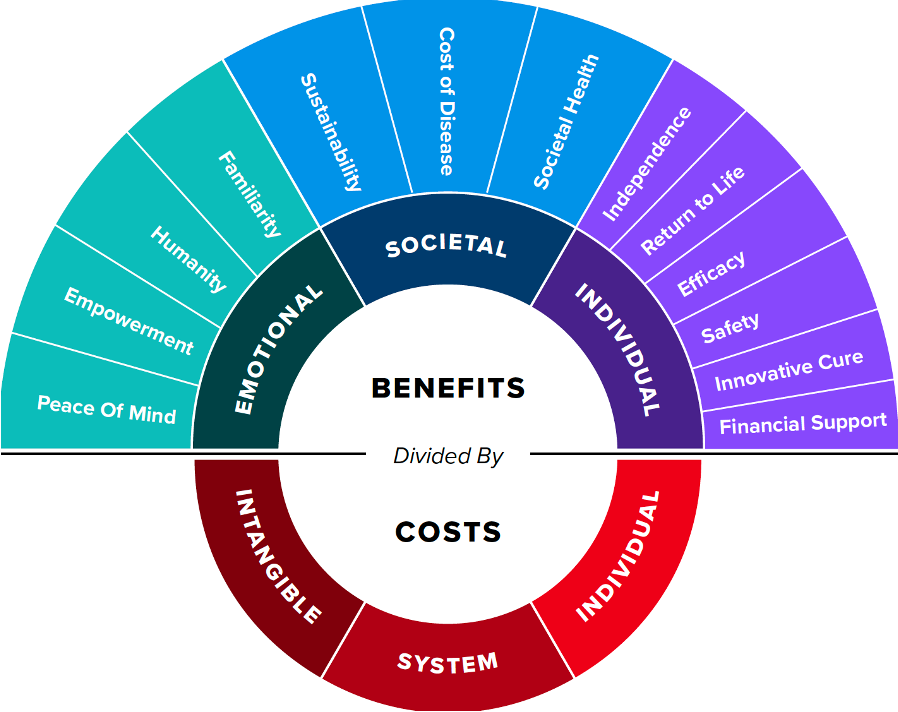
We discovered that at the highest level, benefits are defined across three key dimensions: individual, emotional and societal. These dimensions break down further into thirteen unique drivers measured by 39 individual attributes measured in the survey. For example, attributes focused on treatment success, reliability and alleviating pain naturally clustered together into the “Efficacy” driver. The cost side of the equation is comprised of three key drivers: individual, intangible and system costs, measured by 13 individual attributes. Many attributes didn’t make the cut because they were statistically poor measures of value. This model provides a window into how patients conceptualize the benefits and costs of health care. With this window, we can better advise clients on how to most effectively communicate their value proposition.
When assessing the benefits side of the equation, we discovered that the top two drivers are what we call “Humanity” and “Peace of Mind.” Humanity is about how health care products and services create a personal connection to patients by treating them like individuals, understanding their needs, and being seen as an advocate for them. Peace of Mind is a perception that the health care product or service provides freedom from fear and anxiety, making patients feel safe and secure. When patients assess value, clinical outcomes are important, but they are a threshold expectation. Evoking an emotional benefit (Peace of Mind) and a personalized relationship (Humanity) is more likely to trigger a differentiated value proposition.
The hierarchy we identified across the entire spectrum of health care sectors looks different depending on the individual sector, as well as individual therapeutic areas, products, service offerings and all other parts of the health care system that seek to demonstrate a patient-centric value proposition. The Health Patient Value Model is a framework for helping companies understand the value equation for their patients. How can Reservoir’s Patient Value Model supports your organization? Get in touch with me via email.
There may be no better conversation starter in health care than asking “What does value mean to you?” The question of what constitutes value is probably the most hotly debated question in health care. The answer to that question influences everything from what kind of care is provided to how that care is ultimately reimbursed.
As a communications firm, clients often come to us with that very need: to help them communicate the value proposition of their products and services. While each client brings a different product or service to the table and they may have different audiences to reach, the goal is always to show how their offering is differentiated and adds value to the system and to the lives of the patients they serve. That patient-centric mindset drives them to design better products and services with the patient at the center of every decision and innovation. To achieve patient-centric outcomes, it is essential to be defining value in the way that patients perceive it.
The universal definition of value is benefits divided by cost – if a product provides more benefits than it costs, then it is valuable. To better understand how the industry defines value, we looked at how stakeholders are discussing it and using it to guide their decisions. In addition to the wide variation in definitions, we found that too often in health care, existing value frameworks fail to capture all the drivers that patients consider when thinking about benefits and costs.
Health Technology Assessments (HTAs) are another way of determining value in health care. With HTAs, organizations or governments look at the costs, outcomes and safety of a product or service, then determine how much value is added to the entire health care system. With that calculation, they can assign a starting price for negotiations.
More broadly, value-based care and associated payment models carry specific cost and quality metrics to measure how those across the continuum of care – from clinical laboratories to providers to device manufacturers – deliver value through the products and services they provide. The models attempt to quantify complex factors including patient satisfaction, timeliness and equitability to compare and rank those offering care.
While there are certainly a variety of quantitatively driven value-assessment models, we found few examples of quantitative approaches to understand and respond to the patient perspective across the continuum of care. As a result, companies struggle to communicate the value of their products and services in a differentiating and patient-centric way and patients are dissatisfied with a system that comes short of their expectations.
Reservoir decided to try and fill in some of the gaps. We started a journey to decode the actual attributes that patients consider when assigning value to a product or service in health care, ranging from clinical efficacy to emotional support. Through a series of in-depth conversations with thought leaders in the field and a quantitative survey of patients with varying levels of experience with the health care system, the Reservoir Patient Value Model was born.
Over the coming weeks, we look forward to sharing more about the Patient Value Model, and how it can benefit your organization.
Washington, D.C. – Reservoir Communications Group welcomed Michelle Nealy, a seasoned communications and digital strategist, to its senior team as a Director, building on the firm’s broad advocacy expertise on behalf of its clients.
Before coming to Reservoir, Michelle served as Vice President of Communications and Digital Strategy for Faith in Public Life where she oversaw communications strategy and digital engagement for a wide range of social justice issues. Prior to this, she drove rapid response and crisis management campaigns at the N.A.A.C.P. Previously a reporter for the Associated Press, Michelle has chronicled some of the most important political issues of the 21st century. Michelle holds a B.A. in Journalism from Howard University, and a M.A. in Communications from the University of Maryland, College Park.
Reservoir also welcomed Dan Lemle, Managing Associate, and Liz Irons, Associate, to the firm. Dan will help oversee and support media and content development across Reservoir’s health care clients. Prior to joining Reservoir, he served as communications manager at the Alliance of Community Health Plans (ACHP), a trade association representing the nation’s nonprofit health insurers. Dan has also held communications roles with the National Association of Broadcasters (NAB), the primary organization representing radio and television broadcasters. He has a B.S. in Journalism and a Specialization in Public Relations from Bowling Green State University in Ohio.
Liz recently joined Reservoir as a full-time associate after completing two successful internships with the team. She will support Reservoir’s health care clients with content development, research and social media engagement. Liz graduated from George Washington University with a B.S. in Political Communication and her M.A. in Media and Strategic Communication.
Like most of us, this last year has been unlike any other for college students. From spending our 21st birthdays popping champagne in our childhood homes to having our college activities and events upended, we’ve managed to power through the previously unimaginable.
When it comes to our professional lives, the coveted “perfect internship” also looks a lot different than in years past. As we close out the semester and more offices—including Reservoir’s—begin to transition to in-person work, we now have an opportunity to reflect on the ways in which the unique challenges of interning during a pandemic have helped shape us into the resilient young professionals we are today. Here are some key lessons we’ve learned while interning remotely:
Know When To Speak Up
Interns at Reservoir benefit from a great support system, including regular manager check-ins, team meetings, and lunch and learns. But communication is more difficult in a virtual environment—you can’t stop by a teammate’s desk if a quick question comes up. This generation of pandemic interns has learned to speak up and ask for direction when needed, a critical skill in any profession.
Stay Organized
No one is looking over your shoulder as a remote intern, so organization is key. You might begin the day sifting through emails and Microsoft Teams messages to create an itemized to-do list of the day’s tasks. That list is valuable and will guide you through the workday…that is, until you’re faced with an additional last-minute deadline. Learning to juggle your regular duties—from morning news media scans to research projects—and adjust when a new deliverable pops up is a valuable skill for any work environment, especially if you’re working remotely.
Take Breaks
While working on a variety of different projects from the comfort of your own home, it can be easy to get swept into work and lose track of time. With pandemic workforce burnout creeping up on professionals in all fields, we’ve learned the importance of taking breaks. It’s not always easy to take that time, especially when you’re just starting out and trying to become more acclimated to a new work environment, but research shows that breaks actually make you more productive. A recent study from Microsoft found back-to-back meetings can decrease your ability to focus and engage, causing a measurable buildup in the brain of stress-related beta waves. Incorporating walks into your routine is one way to add breaks into your day, and it may even boost your brainstorming ability. A recent study from Stanford University examining mental tasks that require imagination found walking boosted creative thinking among participants.
Connect with Teammates
Connecting with colleagues is a critical part of any internship—but that can be challenging in a virtual environment. Fortunately, our team at Reservoir has taken the time to form connections with each of us, while also giving us a feel for the company’s culture. Every day at Reservoir is an opportunity to learn and meet new people, each with their own unique experiences across the media and healthcare continuum. “Sitting down” with teammates a quick coffee chat has helped simulate those key water cooler conversations from the comfort of our own homes.
In a year of many challenges, the shift that we’ve all been forced to undertake has made us more resilient, driving us to develop key skills faster than previous generations before us. From shuffling between online classes over Zoom to joining client calls on Microsoft Teams, we’ve all been able to learn and grow in ways we didn’t think possible. Starting an internship during a pandemic has made us the young professionals we are today and we’re grateful for that experience—even if that means missing out on the delicious snacks in the office kitchen.